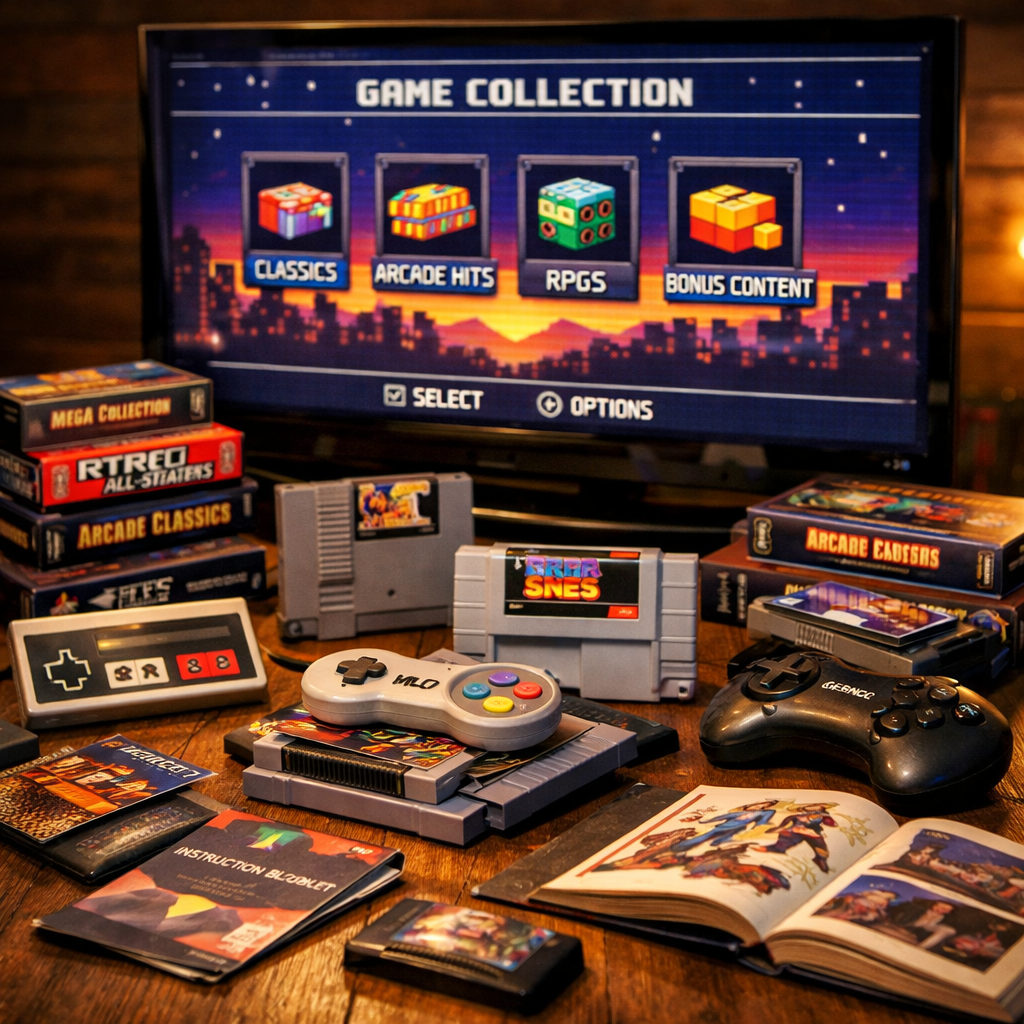
15 Best Retro Game Collections Packed with Classics and Extras
Modern retro compilations matter because they preserve hard‑to‑find classics, add context through museum features, and make play easier with rewind and save states. “A retro game collection is a curated bundle of classic titles reissued on modern platforms, typically with emulation, display options, save states, and archival extras that preserve history while improving accessibility for today’s players.” The best sets combine strong emulation accuracy, thoughtful extras, and great value versus chasing rare originals, as highlighted in HardcoreGamer’s best‑of roundup. Top specialist ports from studios like M2 are widely praised for near‑perfect emulation and high‑quality bonuses, so we favored those releases in particular.
Comparison snapshot (availability and features vary by platform and patch):
| Collection | Platforms | Games | Key Extras | Archival standout | Notable gaps |
|---|---|---|---|---|---|
| Atari 50 | Switch, PS, Xbox, PC | 100+ | Rewind/saves, filters | Interactive timeline with new documentaries | Some third‑party Atari‑era licenses absent |
| Mega Man Legacy Collection | PS, Xbox, Switch, PC | 6 | Rewind/saves, challenge modes | Massive sprite/art gallery | Later games are in Legacy 2 |
| Super Mario All-Stars | SNES (original/NSO), SNES Classic | 4 | Save slots, 16‑bit remasters | Definitive 2D facelift for early Mario | Purists may prefer NES physics |
| Super Mario 3D All-Stars | Switch | 3 | Resolution bumps, control tweaks | Soundtrack player | Super Mario Galaxy 2 not included; digital delisted |
| NES Classic Edition | Mini console | 30 | Suspend points, CRT filter | Authentic controllers | Fixed library |
| SNES Classic Edition | Mini console | 21 | Rewind/saves, CRT/scanlines | Official Star Fox 2 release | Fixed library |
| Castlevania Advance Collection | PS, Xbox, Switch, PC | 4 | Rewind/saves, music player | Regional ROMs and art | Focuses on GBA era only |
| Castlevania Anniversary Collection | PS, Xbox, Switch, PC | 8 | Saves, manuals, variants | Early series history in one set | 16‑bit Metroidvanias not here |
| Contra Anniversary Collection | PS, Xbox, Switch, PC | 10 | Difficulty/rapid‑fire, variants | Arcade/console lineage | Modern entries excluded |
| Sega Genesis Classics | PS, Xbox, Switch, PC | 50+ | Rewind/saves, filters | Broad platform/RPG catalog | Licensing limits some favorites |
| Rare Replay | Xbox | 30 | Snapshots, docs, timeline | “Rare Revealed” featurettes | A few titles require BC installs |
| TMNT Cowabunga Collection | PS, Xbox, Switch, PC | 13 | Rewind/saves, online (select), guides | Massive strategy guide scans, art | Not every game has online |
| Disney Aladdin & The Lion King | PS, Xbox, Switch, PC | Multi‑version | Rewind/saves, watch‑assist | Multiple platform versions preserved | Earlier SKUs vary by included titles |
| Disney Afternoon Collection | PS, Xbox, PC | 6 | Challenges, filters, museum | NES licensed classics in one place | No Switch release |
| Capcom Beat ’Em Up Bundle | PS, Xbox, Switch, PC | 7 | Local/online co‑op, gallery | Arcade‑first fidelity | Online quality varies by platform |
Retro Gaming Blog
We’re preservation‑minded enthusiasts who balance nostalgia with practical buying advice. Expect research‑backed picks across eras, plus hands‑on guidance for displays, controllers, and latency so your setup feels authentic. New to collecting? Start with our collecting hub or explore our retro culture features for deeper context.
Atari 50
Atari 50 regularly tops “best retro compilations” lists for its documentary‑style presentation. Rather than a flat menu, it weaves games into interactive timelines packed with developer interviews, design documents, and short features, elevating simple curios into playable history lessons. The museum mode adds crucial context to early arcade and console milestones and makes experimentation inviting, even when a game’s charm lies more in influence than depth.
Mega Man Legacy Collection
This set bundles the original six NES classics with museum mode, challenges, and rewind/save options that make 8‑bit difficulty fair and learnable. Emulation is sprite‑accurate and responsive, while galleries and sound tests double as a study guide for Capcom’s level design philosophy. If you value challenge modes and historical art, this is a model of how to modernize without losing the feel of the originals.
Super Mario All-Stars
Nintendo’s SNES compilation remains a definitive way to play the early Mario platformers with remastered 16‑bit visuals and audio. The core level designs are intact, but physics and presentation are cleaner than the NES carts, making it ideal for newcomers. Purists who prefer the exact NES timing can still seek the originals, but All‑Stars is a polished, accessible package that respects the source.
Super Mario 3D All-Stars
A convenient collection of three 3D‑era Mario ports on Switch, with resolution bumps, widescreen where applicable (notably Sunshine), and light control tweaks for modern play. It includes a music player but few museum features, and Super Mario 64 remains 4:3. Availability note: the digital version had a limited sales window, and Super Mario Galaxy 2 is absent.
NES Classic Edition
Mini consoles deliver instant nostalgia with authentic controllers and living‑room simplicity—no cartridge hunting, no setup headaches. NES Classic’s 30‑game lineup, suspend points, and CRT filters make it a plug‑and‑play time capsule that feels right on a couch.
Mini consoles vs. software compilations:
- Latency: fixed hardware paths often mean consistent input response end‑to‑end.
- Controller feel: first‑party pads help muscle memory; third‑party options vary.
- Display/options: compilations typically offer more filters, aspect controls, and online play. For quick setup and lag tips, see our simple guides on Retro Gaming Blog.
SNES Classic Edition
SNES Classic mirrors the NES mini’s convenience with a flagship 16‑bit library, including an official release of Star Fox 2. Save states, rewind, and scanline filters make the library both approachable and authentic. Compared to skyrocketing cartridge prices, it’s an easy, faithful entry point for SNES classics.
Castlevania Advance Collection
Three GBA Metroidvania favorites plus Dracula X arrive with quality emulation, rewind/save options, soundtrack players, and clean art galleries. Regional versions and quick‑swap filters let you tailor difficulty and aesthetics. It’s the best way to experience portable‑era Castlevania on a big screen without losing the handheld vibe.
Castlevania Anniversary Collection
A broad historical sampler covering the series’ early era across NES, early handhelds, and arcades. Expect manuals, regional variants, and modern QoL features like suspend saves. It’s a superb on‑ramp for newcomers who want to understand Castlevania’s foundations before tackling the more elaborate Metroidvanias.
Contra Anniversary Collection
From arcade originals to home console staples, this set assembles the run‑and‑gun lineage with optional difficulty assists, rapid‑fire toggles, and regional and arcade variants. It’s tailor‑made for co‑op nights and high‑score chasers who appreciate accurate emulation and a little flexibility for learning the toughest loops.
Sega Genesis Classics
A broad Genesis/Mega Drive catalog that’s easy to recommend on value alone. Rewind, save states, scanlines, and control remapping modernize a library spanning shooters, platformers, brawlers, and standout RPGs. On PC, select titles include online play. If you want sheer breadth at a friendly price, start here.
Notable standouts to sample first:
- Streets of Rage 2 (brawler), Sonic 2 (platformer), Gunstar Heroes (run‑and‑gun), Phantasy Star IV (RPG), and Beyond Oasis (action‑adventure).
Rare Replay
A studio anthology that doubles as a playable documentary. Thirty games across genres are wrapped in a timeline of unlockable videos, interviews, and challenges that chart Rare’s evolution from 8‑bit experiments to 3D icons. As a retrospective, its curated extras are as valuable as the games themselves.
Teenage Mutant Ninja Turtles The Cowabunga Collection
Thirteen arcade and console TMNT classics in one polished, value‑packed set. Extras include online play for select titles, robust button mapping, strategy guide scans, and deep art galleries. It’s widely praised by players for completeness and care, especially for couch co‑op fans who grew up on the arcade hits.
Included highlights:
- TMNT (Arcade), Turtles in Time (Arcade/SNES), Hyperstone Heist (Genesis), Tournament Fighters (NES/SNES/Genesis).
Disney Classic Games Aladdin and The Lion King
This collection preserves multiple console versions with rewind, save states, art galleries, and documentary extras. Version parity means offering several regional or platform variants so players can experience differences in difficulty, visuals, and mechanics across releases. It’s a smart, preservation‑minded approach to licensed classics that were scattered across platforms.
Disney Afternoon Collection
A clean, nostalgia‑hit for NES‑era Capcom platformers. Challenge modes, museum features, and solid filters modernize six licensed favorites while keeping their brisk feel and tricky jumps intact. Compared to original carts, the QoL upgrades make these tough classics kinder without dulling their edge.
Capcom Beat ’Em Up Bundle
Seven arcade‑perfect brawlers with local and online multiplayer, plus museum galleries for cabinet art and design docs. Final Fight, Knights of the Round, and Battle Circuit headline a lineup ideal for drop‑in co‑op nights. Netcode and lobbies vary by platform, but the core emulation and options are strong.
How we chose these collections
Our criteria emphasized: accurate emulation, quality‑of‑life features (rewind/save states), archival content (interviews, galleries), breadth/curation, platform availability, and community consensus. Specialist ports by teams like M2 are widely praised for near‑perfect emulation and premium bonuses, a key factor in our picks. We also cross‑checked top‑tier recommendations recognized by IGN and HardcoreGamer to align with broader critical consensus. We test on modern displays and note input latency and control feel when it meaningfully affects play.
What to look for in a retro collection
Use this quick checklist:
- Platform fit and availability (physical/digital).
- Emulation accuracy and input response.
- Extras you’ll actually use: rewind, save states, online play.
- Controller feel and comfort.
- Museum features and regional variants.
- Licensing gaps versus price.
Value vs originals: compilations can beat the cost of rare carts by a wide margin; for smaller publishers, skim community bug reports before buying to ensure emulation and QoL meet expectations.
Emulation quality and accuracy
Emulation accuracy describes how faithfully software replicates original hardware behavior—timing, graphics, audio, input responsiveness, and quirks. High‑accuracy emulation preserves intended gameplay feel and visuals, including correct aspect ratios and performance limits, ensuring classics play as designed even on modern systems. Premium releases aim to match original behavior, and groups like M2 are lauded for hitting those marks. Community lag tests and filter comparisons are useful for validating claims.
Extras and preservation value
The best sets add galleries, documentaries, developer materials, and rewind/save states that reduce friction and add historical context. Some reissues use suspend points rather than true save states, which can limit mid‑action recovery—check the feature list. Best Extras to Look For:
- Developer interviews and short docs
- Concept art and high‑resolution scans
- Regional and platform variants
- Challenge modes and online play
Control feel and latency
Input latency is the delay between pressing a button and seeing the action on screen. Lower latency preserves timing‑sensitive gameplay in platformers, shooters, and fighters. Tips:
- Prefer wired controllers; enable TV “Game Mode.”
- Avoid extra video processing and long HDMI chains.
- Favor compilations known for responsive emulation.
- Mini consoles can offer consistent end‑to‑end latency.
Regional versions and licensing gaps
Licensing can remove iconic entries, and QA/feature depth may vary for smaller publishers. Call out JP/US/EU variants where included, as they can change difficulty, censorship, and even performance. When possible, check sets’ product pages for omissions or delisted items before you commit.
Physical vs digital availability and price
Compare compilation prices to original cartridges; collections and minis are often excellent value versus rarity. For physical collecting, eBay remains a dominant marketplace, while GOG.com offers DRM‑free ownership and a 30‑day refund policy for many PC classics. Limited‑run physical editions, regional exclusives, and timed digital windows can all affect long‑term availability.
Frequently asked questions
Are these collections good replacements for original cartridges?
They’re excellent for convenient, affordable play with extras like rewind and save states. On Retro Gaming Blog, we call out which sets feel closest to original hardware.
What extras actually improve the experience for new players?
Rewind, save states, and modern tutorials reduce frustration and speed up learning; on Retro Gaming Blog we highlight sets that implement these well. Museum galleries and developer notes add context, while scanlines and aspect controls improve clarity on modern screens.
How can I reduce input lag when playing retro collections on modern TVs?
Turn on Game Mode, use wired controllers when possible, and avoid extra video processing; on Retro Gaming Blog we share simple setup checklists. Choose collections noted for responsive emulation to further cut latency.
Should I buy physical editions or go digital for these compilations?
Physical offers collectability and resale, while digital is convenient and often discounted; Retro Gaming Blog notes availability quirks as they change. If availability seems uncertain, physical provides permanence; if you value quick access, digital is great.
Why are some iconic games missing from certain collections?
Licensing rights, music clearances, and regional agreements often limit what publishers can include. We flag these gaps in our picks on Retro Gaming Blog.