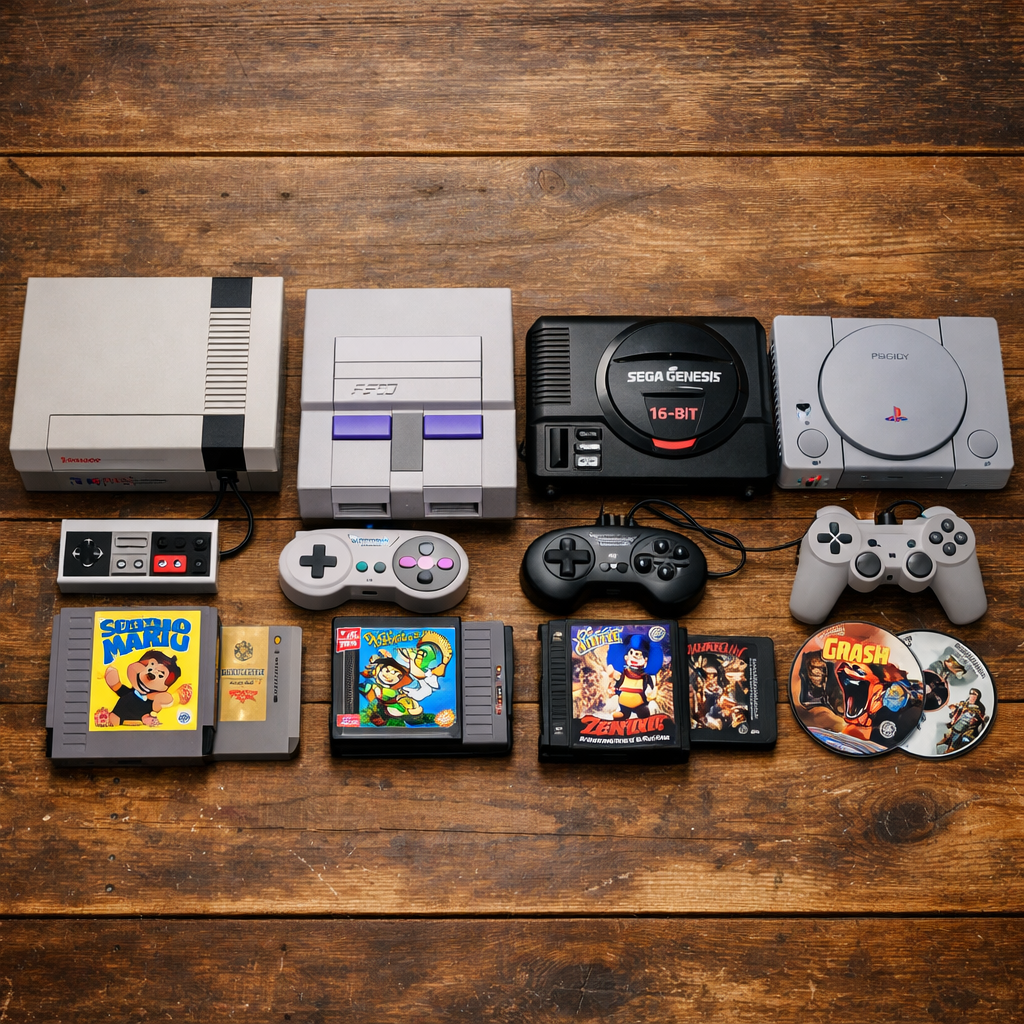
Before You Buy a Console, Compare Exclusive Libraries That Matter
If you’re asking which console has the best exclusives in 2026, start with the games you can only play there—and how you’ll access them over time. “Exclusive titles and subscription access often matter more long-term than raw teraflops,” notes a gaming console buying guide, which also highlights how subscriptions and backward compatibility shape value far beyond specs. An exclusive game is a title available only within a platform’s ecosystem for a given window—sometimes truly console-only, sometimes console-plus-PC—often bundled with platform-specific features, marketing, or DLC, and increasingly tied to subscription catalogs that change monthly. This article helps you cut through PS5 exclusives vs Xbox debates, weigh Switch 2 exclusives expectations, and judge Game Pass value and backward compatibility against your budget and display. For collectors and families alike, we also fold in Retro Gaming Blog’s retro-era perspective and setup advice from the CRT days to today’s 4K living rooms—and where exclusives shine most. For long-haul value insights, see Retro Gaming Blog’s guide on which consoles have the most valuable games.
Why exclusives decide console value
Exclusives do more than sell systems—they define how a console feels for years, from first-party epics to indie darlings that debut in one ecosystem. “Ecosystem and library access is critical when buying a console; it can be a deal breaker,” and the total cost can quietly shift if you add online services or subscription tiers (often $0–$120 extra per year). Platform-by-platform buying guides such as TechRadar’s best consoles roundup consistently frame decisions around libraries, not teraflops. At Retro Gaming Blog, we evaluate consoles by the games and access model you’ll actually use.
A quick fit guide:
| Play style (what you love) | Best-fit platform(s) | Example exclusives/features | Why it matters |
|---|---|---|---|
| Story-driven, cinematic single-player | PS5 | Marvel’s Spider‑Man 2; The Last of Us Part I; DualSense support | Prestige narratives and controller-led immersion |
| Sandbox, co-op, and service-backed play | Xbox Series X | S | Forza Horizon; Halo Infinite; Sea of Thieves; Game Pass |
| Family handheld and couch co-op | Nintendo Switch (and Switch 2) | The Legend of Zelda; Mario Kart; Pokémon | Portable-first sessions; approachable multiplayer |
| Competitive multiplatform shooters | PS5/Xbox (match your friends) | Cross-play staples + 120Hz modes | Social ecosystem and display features win here |
Subscriptions, add-on storage, and required online memberships can tilt the effective price, so judge the library you’ll actually play—then pick the hardware that best serves it.
How exclusives evolved from the ’90s golden age to today
In the ’90s golden age, mascots and controllers sold systems—Sega’s blast processing bravado, Nintendo’s iconography, and light guns like the NES Zapper defined living rooms. Magazine cover wars and cartridge scarcity pushed true platform-only hits. As discs arrived, publishers leaned into brand mascots and cinematic marketing. The 2010s brought studio acquisitions and timed deals; today, subscriptions and cross-save ecosystems steer where you play. Handhelds now merge living-room and commute time: “Handhelds trade raw console power for portability and convenience,” and modern OLED screens make retro palettes pop. At Retro Gaming Blog, we’ve tracked this arc from CRTs to OLEDs, and the throughline is access over specs.
Timeline snapshot:
- Cartridges + mags → Disc-era mascots → Studio acquisitions → Subscription-era access and cloud saves
What counts as an exclusive now
- Console exclusive: A game released on only one console family for the foreseeable future (it may also appear on PC). Expect platform-specific features, DLC windows, and heavy storefront promotion.
- Timed exclusive: A game that launches first on one platform for a set window (often 3–12 months) before arriving elsewhere.
Exceptions and fine print: Some consoles will play your old discs but require repurchasing digital editions for modern features or upgrades, and certain “console exclusives” still show up on PC storefronts.
Keywords to know: console exclusive definition, timed exclusive meaning, platform exclusives vs PC.
How to compare exclusive libraries
Use this five-step, repeatable method we rely on at Retro Gaming Blog:
- List must-play franchises and genres; rank by urgency.
- Verify backward-compatibility and upgrade paths (saves, DLC entitlements, disc vs digital).
- Compare subscription catalogs versus à la carte totals for your list.
- Plan storage: modern AAA titles are commonly 50–100GB; some exceed 150GB. A 512GB drive can hold roughly 5–8 big games before you juggle installs.
- Match features to your TV/handheld use. “If your TV tops out at 1080p/60Hz, 4K/120Hz console features will be wasted.”
PlayStation 5
Sony’s identity rests on narrative-forward first-party hits with premium production values, often enhanced by the DualSense controller’s haptics and adaptive triggers. If you prize single-player prestige and cinematic action, PS5’s library and accessories bend design in your favor. The disc model also brings UHD Blu‑ray playback and 4K output alongside digital storefront convenience.
Signature series and standout genres
If you love cinematic action-adventure and stylish RPGs, PS5’s exclusives list is a showcase. Recent flagships like Marvel’s Spider‑Man 2 and The Last of Us Part I exemplify the platform’s “prestige single-player” lane, often layering DualSense cues for set pieces and traversal. In 2026 roundups, PS5 continues to be positioned as a leader for high-profile, story-first releases that feel authored around the controller.
Backward compatibility and PS4 carryover
Before switching, confirm your digital library’s PS4-to-PS5 entitlements, save transfers, and any paid upgrade paths—especially for deluxe editions and DLC. Physical owners should check disc behavior per title. The PS5 Slim delivers the same core experience in a smaller chassis, with modular disc options for collectors.
DualSense impact on exclusive design
DualSense haptics use precise vibration motors and adaptive triggers to simulate textures, tension, and impact, amplifying game feedback beyond rumble. In supported exclusives, it can change play perception, cue mechanics, and deepen immersion—particularly in shooters, racers, and cinematic action. As many reviews note, “The PS5 DualSense can deliver transformative haptic feedback and adaptive trigger effects,” and battery life is commonly around 10 hours in testing, according to an overview of modern consoles.
Cost, storage, and subscription factors
Baseline PS5 storage is 825GB (about 667.2GB usable on early models), while Slim variants frequently ship with 1TB. Tom’s Guide’s best game consoles summary underscores that internal space fills quickly, so budget $60–$100 for a 1TB NVMe expansion. If you’re eyeing PS5 Slim vs Pro talk, remember the moral: exclusives you’ll finish matter more than raw teraflops or a larger internal drive.
Xbox Series X and Series S
Xbox pairs strong hardware and media features with unmatched value via Game Pass. Series X targets high performance (roughly 12 TFLOPS), and the ecosystem supports Dolby Vision HDR and Dolby Atmos audio on supported displays. Microsoft’s studio portfolio—folding in Bethesda and Activision Blizzard—broadens exclusive access over time.
Signature series and standout genres
Xbox shines with system-driven sandboxes and co-op: Forza Horizon’s open-world racing, Halo Infinite’s multiplayer backbone, and Sea of Thieves’ seasonal adventures thrive under a services model. Tom’s Guide’s PS5 vs Xbox vs Switch comparison highlights both the performance ambitions and first-party pipeline, while Quick Resume remains a lauded quality-of-life feature when it behaves.
Backward compatibility depth and Game Pass value
Series X|S deliver robust backward compatibility that spans original Xbox through 360 and Xbox One libraries, with resolution and frame boosts on many titles. Stuff’s best console guide emphasizes Game Pass as a headline benefit, frequently delivering day-one access that turns “fewer headline exclusives” into “more games you’ll actually try” across a year.
Series S considerations for exclusives
Series S is the value play: a smaller, quieter, digital-only box with a 512GB SSD (~364GB usable). Expect lower target resolutions and more active storage management; it’s made for affordability and subscription-centric play. Plan for bandwidth and, if needed, external storage to keep your library nimble.
Cost, storage, and subscription factors
Run a 12‑month comparison: Game Pass (Core/Console/Ultimate) versus buying your must-play exclusives outright. Even 825GB–1TB fills fast with modern installs, so plan regular uninstalls or expansion. If you want Dolby Vision/Atmos, Series X is a safer bet; PS5 does not support Dolby Vision even on capable TVs, as noted by Wirecutter’s best game consoles guide.
Nintendo Switch and Switch 2
Nintendo’s first-party lineup—Mario, Zelda, and Pokémon—remains the platform’s biggest draw, with art direction and mechanics that sidestep pure horsepower. Sessions under load can run near three hours on the go, reinforcing portable-first design. Expect Switch 2 to lift GPU headroom, but portability will stay the priority.
Signature series and standout genres
Pillars include inventive platformers, action-adventures, party games, and family co-op. Nintendo’s exclusives lean into timeless visuals and evergreen systems over bleeding-edge tech. The platform is also a haven for indies—metroidvanias and pixel platformers feel right at home thanks to instant-on handheld play and approachable control schemes.
Handheld play and family co-op appeal
Portability translates into low-friction sessions: road trips, couch co-op, and quick dailies are built in. For family comfort, consider grips for Joy-Con and controllers with Hall Effect joysticks; magnet-based sensors mitigate stick drift and can extend controller life in busy households.
Performance expectations for third-party titles
Many multiplatform releases are downscaled on Nintendo hardware to preserve playability. If you’re display-sensitive, use docked modes for sharper results. Typical targets by platform:
| Platform | Typical resolution targets | 120Hz support | Notes |
|---|---|---|---|
| PS5 | 4K/60 (up to 4K/120) | Yes | Feature set depends on game mode |
| Xbox Series X | 4K/60 (up to 4K/120) | Yes | Dolby Vision HDR on supported titles/TVs |
| Switch (docked/handheld) | 1080p/720p | No | Portable-first, dynamic scaling common |
Cost, storage, and online factors
Budget for a large microSD; with 50–100GB games increasingly common, internal space vanishes quickly. Battery life varies by title and brightness (roughly three hours under heavier loads). Nintendo Switch Online adds retro libraries and cloud saves for family-friendly value.
Cross-platform shifts and timed exclusives to watch
A timed exclusive debuts on one console for a defined period before releasing elsewhere, sometimes with early DLC or feature flags. Typical wait times run 3–12 months. Examples:
- Character-driven RPGs landing first on PS5, with PC/Xbox later in the year
- Indie action-adventures premiering on Xbox via Game Pass, then arriving on PS5/Switch
- JRPGs incubating on Switch before wider ports
Also note format gaps that may affect your TV match-up (e.g., PS5 lacks Dolby Vision while Xbox supports it).
Indie games shaped by retro design on each platform
Retro sensibilities thrive across ecosystems:
- Switch: Celeste, A Short Hike, and Metroid Dread-inspired indies flourish; Octopath Traveler was a timed console exclusive at launch.
- PS5: Kena: Bridge of Spirits and Bugsnax debuted as timed console exclusives, with DualSense-enhanced indies using nuanced haptics for platforming cues.
- Xbox: Tunic and The Artful Escape used Game Pass discovery to reach massive audiences at launch windows, translating arcade-loop appeal into modern momentum.
From CRT-era color palettes to tight arcade loops, ’80s–’00s design language still shapes what “feels” exclusive—even when the window is temporary. Retro Gaming Blog spotlights these throwback cues when recommending platform fits.
Accessories and display tips for playing exclusives right
- Confirm your console ships with an Ultra High Speed HDMI cable; replace if not.
- Match display to features: if your TV caps at 1080p/60Hz, you won’t benefit from 4K/120Hz modes.
- Checklist: enable your TV’s low-latency/ALLM mode; verify HDR support (Xbox can offer Dolby Vision on capable sets, while PS5 uses HDR10); check eARC for Atmos soundbars; and calibrate HDR per console. For disc collectors, Wirecutter’s best game consoles guide also outlines which models include UHD Blu‑ray drives.
Which console truly has the best exclusives
- PS5: Best for prestige single-player with DualSense immersion; strong 2026 showings anchor the “cinematic action” lane.
- Xbox: Best for value and variety via Game Pass, robust backward compatibility, and media features that pair well with modern TVs.
- Nintendo: Best for timeless first-party worlds and family handheld play that fits real-life schedules.
Reinforcing the thesis: “Exclusive titles and subscription access often matter more long-term than raw teraflops.” Choose the library you’ll love, then the box that fits your display and budget. That’s the Retro Gaming Blog approach.
Buying checklist to match your tastes and setup
- Prioritize which exclusives you want (by franchise/genre).
- Verify backward compatibility for your discs, digital purchases, and saves.
- Compare 12-month Game Pass vs buying games outright for your must-play list.
- Budget for at least 1TB total storage or expansion; SSD add-ons typically add $60–$100.
- Match console output to your TV/handheld habits (1080p vs 4K, 60Hz vs 120Hz).
- MSRP context: Series X is around $499.99; Series S around $299.99, per IGN’s how to choose a console.
Frequently asked questions
What is the difference between console exclusive and timed exclusive
At Retro Gaming Blog, a console exclusive releases only on one console family (sometimes also on PC). A timed exclusive launches first on one console for a set period before arriving elsewhere.
Do backward-compatible versions feel authentic on modern displays
They can, especially if the console supports good scaling and low-latency modes. Retro Gaming Blog’s setup tips favor proper TV settings and an Ultra High Speed HDMI cable to preserve responsiveness and clarity.
How much storage should I plan for if I focus on exclusives
Retro Gaming Blog recommends at least 1TB. Big releases are often 50–100GB each, so smaller internal drives fill fast; budget for a speedy expansion to avoid constant deletes.
Are subscription services better than buying exclusives outright
Subscriptions deliver breadth and day-one access; buying suits collectors and favorites you’ll replay. Retro Gaming Blog suggests comparing a 12‑month sub price against how many must-plays you’ll actually finish.
Will a new hardware revision change exclusive performance or features
Revisions can add storage, smaller designs, or performance headroom, but the library matters most. Retro Gaming Blog advises picking the platform with the games you love, then the model that matches your display and budget.