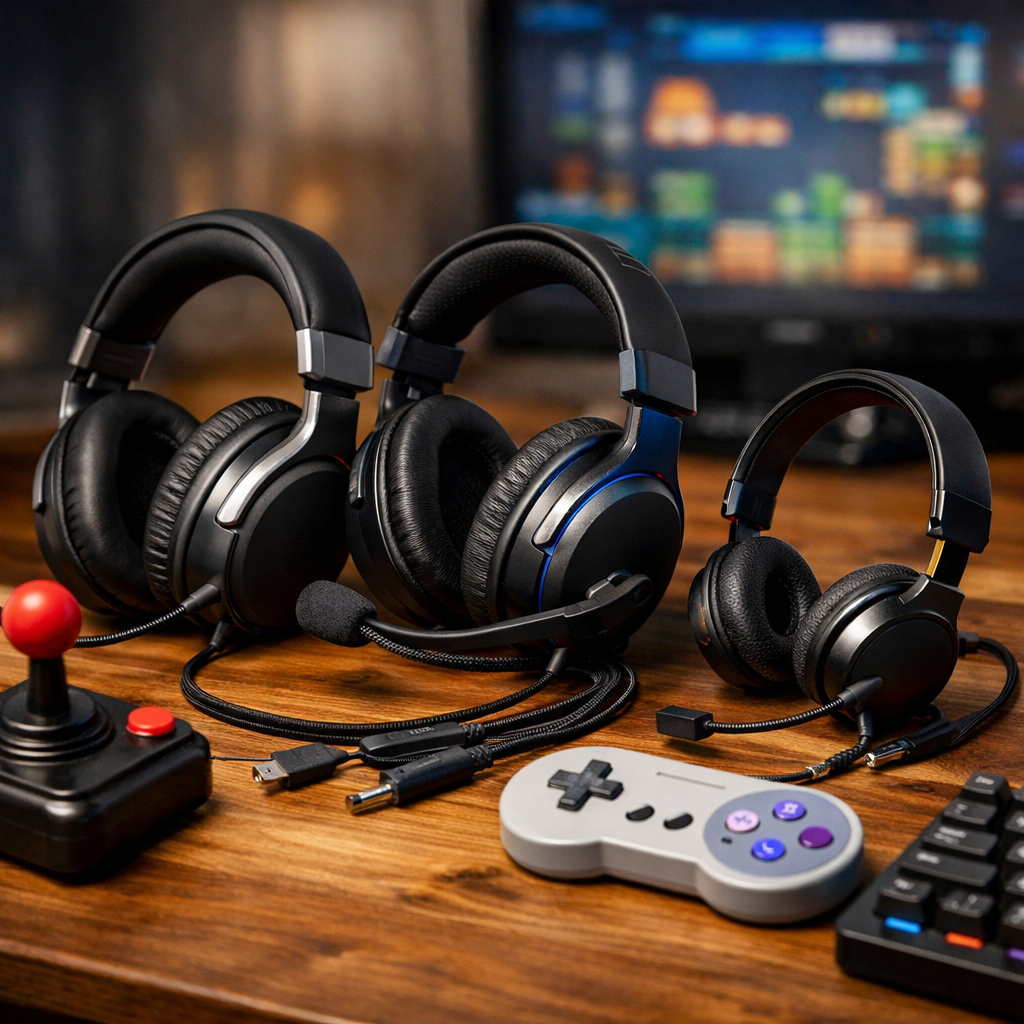
Best Cross-Platform Gaming Headsets for Console and PC in 2026
If you bounce between PS5, Xbox, Switch, PC, and a phone, the best cross-platform wireless gaming headset for console and PC in 2026 should feel invisible—seamless switching, lag-free audio, clear chat, and a battery that won’t die mid-raid. This guide zeroes in on multi-radio headsets (2.4GHz dongle plus Bluetooth), stable sub‑15ms wireless, long-life or hot‑swappable batteries, and spatial audio support. We’ve tested and vetted options for competitive play, couch co-op, and retro nights on a CRT. Below you’ll find the quick answers on what works across platforms, which wireless modes matter, and which models fit families, tinkerers, and audiophiles.
Strategic Overview
Cross-platform headsets now revolve around three pillars: multi-radio connectivity for frictionless device swaps, low-latency 2.4GHz for gameplay, and dependable microphones for team chat. Independent roundups consistently place a few families at the top—SteelSeries Arctis, Astro A50, Razer BlackShark, and Audeze—for their mix of comfort, connectivity, and sound quality, with buyer-friendly insights from the likes of the GamesRadar best gaming headsets guide and other pro test labs (see GamesRadar’s long-running roundup for a broad market snapshot). Our long-term testing reaches the same conclusion. Industry trend pieces flag simultaneous 2.4GHz+Bluetooth and sub‑15ms wireless as 2026 must-haves, alongside better battery longevity and app-driven EQ/spatial features (see the 2026 trends buyer’s guide from Iwantek for a concise overview). We treat those as table stakes.
At a glance:
- Flagship “do-it-all” headsets: best for multi-device households, streamers, and Discord-on-phone + console play.
- Mid-range wireless: long battery life, cross-platform dongles, and game presets without premium price tags.
- Wired heroes: universal 3.5mm/USB support, zero-charge peace of mind, and best value for retro consoles and handhelds.
Retro Gaming Blog
We grew up tuning CRT geometry, swapping AA batteries before a Street Fighter II tournament, and reading ’90s magazine headset “shootouts” that felt like cheat codes for your ears. Today’s pick should serve as a bridge: modern multi-radio convenience that still plays nice with an AV switcher, a 3.5mm jack, or a Japan-imported mini-console. If you’re upgrading your display chain, pair your headset with clean RGB mods or a 4K-friendly setup for the best of both eras; and for family nights, prioritize easy switching and volume-safe defaults over studio-grade specs. Our picks prioritize compatibility and ease of use over flashy extras.
SteelSeries Arctis Nova Pro Wireless
If you want one headset to rule console, PC, and mobile, this is the flagship to beat. It supports lag-free 2.4GHz, Bluetooth, and wired modes; uses Premium High Fidelity 40mm drivers; and carries a ClearCast Gen 2 bidirectional mic with hybrid active noise canceling. The dual-battery system nets roughly 22 hours per pack, so you can hot‑swap and keep playing (core specs documented in the GamesRadar best gaming headsets roundup). Review teams widely praise it as a premium, versatile choice with strong software and chat clarity—IGN’s best gaming headset picks call out its high-end execution as a quality signal.
Use it for:
- Seamless device switching and console+Discord-on-phone simultaneously via 2.4GHz + Bluetooth.
- Competitive lobbies where the bidirectional boom keeps chatter intelligible.
- Streaming with easy sidetone and EQ tweaks.
Astro A50 X
The A50 X is the easiest living-room hub for multi-console + PC setups. Its base station plugs into Xbox Series X|S, PS5, and PC at once, acting as an HDMI switcher so you preserve high-refresh video paths and skip cable juggling. It also supports simultaneous Bluetooth + 2.4GHz and ties into console-ready EQ apps for quick profile swaps (see StreamTechReviews’ A50 X breakdown for the HDMI-switching and dual-radio details). With graphene‑coated 40mm drivers and a 20Hz–20kHz spec floor in mainstream coverage, it’s a couch player’s dream—especially for households that rotate between platforms in one session.
Audeze Maxwell 2
Audiophile-friendly and marathon-ready, the Maxwell 2 is a single-player immersion specialist with planar magnetic drivers and 80+ hour battery life. Planar magnetic drivers use a thin diaphragm with embedded conductors suspended in a magnetic field to move air evenly across its surface. Compared with dynamic drivers, planars typically yield cleaner transient response, lower distortion, and wider imaging—qualities that benefit positional cues and music detail. Tom’s Hardware highlights the Maxwell’s audiophile-grade tuning and notes that console-specific variants exist; the Xbox version usually includes a Dolby Atmos license and runs pricier as a result.
Razer BlackShark V3 Pro
This is the competitive-leaning wireless pick: lightweight, stable, and praised for a clear sidetone mic—Wirecutter calls it a top PC choice for comfort and clarity. The BlackShark V3 family features 50mm Gen‑2 TriForce Titanium drivers, a 12–28,000 Hz response, and a 10 ms wireless mode built for ultra‑low lag in supported scenarios, as covered by PC Gamer’s best gaming headset guide. If you value tight imaging and sub‑15ms dongles for ranked play but still want cross-platform flexibility via dongle/Bluetooth, start here.
SteelSeries Arctis Nova 5
A well-priced mid-range wireless headset with a cross-platform dongle, low-latency 2.4GHz, Bluetooth for calls, and a generous 60‑hour class battery. It layers in game-specific EQ profiles and polished app support, drawing on SteelSeries’ comfort-first design language. If you’re debating Nova Pro versus Nova 5, the Nova 5 trims features like hot-swappable batteries and ANC for a lower price while preserving the everyday win: lag-free console/PC play with easy profile swaps. It’s the definition of a mid-range wireless headset that checks the key boxes.
SteelSeries Arctis Nova 3
A budget-to-mid alternative that keeps multi-radio convenience. Expect Bluetooth + 2.4GHz dongle support, 40mm neodymium drivers, and batteries rated around 30 hours on 2.4GHz and 40 hours on Bluetooth—figures commonly cited in mainstream roundups like GamesRadar. For students or families who want one headset for PC, PS5, Switch, and mobile with light EQ via SteelSeries software, Nova 3 hits the sweet spot without creeping into premium pricing.
HyperX Cloud III
The wired/value hero that just works. With a comfortable fit and a clear, dependable mic, it’s recommended by community roundups for value and reliability across anything with a 3.5mm jack, including retro consoles and handhelds (see this 2026 Reddit community review of affordable headsets). If you travel, hop between old and new platforms, or just want zero charging drama, Cloud III delivers consistent results.
Turtle Beach Atlas Air
An open-back wireless designed for comfort and an airy soundstage, great for long PC/console sessions where isolation isn’t critical. Open-back headsets vent sound through the earcups, creating a wider, more natural soundstage but leaking sound externally. Closed-back headsets seal the cups, improving isolation and bass punch but narrowing perceived space. If you play strategy epics, single-player adventures, or retro soundtracks where staging matters more than raw isolation, Atlas Air fits the bill.
Turtle Beach Airlite Fit
An ultra-budget entry for casual console and PC gaming, perfect as a family spare or starter set. The standout is price—commonly listed around $27.99/£19.99 in mainstream buying guides like GamesRadar—paired with a comfort-first design. You won’t get ANC or deep app EQ, but for couch co-op and everyday voice chat, the analog/dongle simplicity is tough to beat.
Beyerdynamic MMX 300
A wired, pro-audio-leaning choice with excellent passive isolation and a broadcast-capable boom mic. IGN’s best gaming headset coverage spotlights the MMX line’s high-end approach and 45mm “Stellar.45” drivers that carry Beyerdynamic’s studio DNA. Universal 3.5mm connectivity (plus adapters) makes it a natural for streamers and enthusiasts who want studio-grade tuning for retro OSTs and modern competitive play without any wireless interference.
Buying guide for cross-platform headsets
Map your needs to features before you buy:
- Device switching: look for simultaneous 2.4GHz + Bluetooth to mix console audio with phone chat.
- Low-latency: favor dongles that advertise sub‑15ms modes; avoid Bluetooth-only for competitive.
- Mic quality: a good boom with sidetone and noise rejection beats pinhole mics.
- Comfort: prioritize clamp balance, breathable pads, and under‑350g weight.
- Battery: hot-swap systems or 60–80+ hour packs reduce charging friction.
Quick comparison table
| Headset | Connectivity (2.4GHz/Bluetooth/3.5mm) | Latency notes | Mic type | Battery life | Platform notes | Price tier |
|---|---|---|---|---|---|---|
| SteelSeries Arctis Nova Pro Wireless | 2.4GHz + BT + wired | Sub‑15ms class on 2.4GHz | Bidirectional boom (ClearCast Gen 2) | ~22h per swappable cell | Works across PC/PS/Xbox variants; dual‑radio simultaneous | Premium |
| Astro A50 X | 2.4GHz + BT; HDMI base | Console-safe 2.4GHz | Boom | ~20–24h typical | Base acts as HDMI switch for PS5/Xbox/PC | Premium |
| Audeze Maxwell 2 | 2.4GHz + BT + wired | Low-latency 2.4GHz | Boom | 80+ hours | Xbox variant includes Dolby Atmos license | Premium |
| Razer BlackShark V3 Pro | 2.4GHz + BT + wired | 10 ms wireless mode | Detachable boom | ~70h (varies by gen) | Strong PC support; console via dongle/BT | Mid‑high |
| SteelSeries Arctis Nova 5 | 2.4GHz + BT | Low-latency 2.4GHz | Boom | ~60h class | Cross-platform dongle variants | Mid‑range |
| SteelSeries Arctis Nova 3 | 2.4GHz + BT | Low-latency 2.4GHz | Boom | ~30–40h | Casual cross-platform fit | Budget‑mid |
| HyperX Cloud III | 3.5mm + USB (varies) | Wired = no lag | Boom | N/A (wired) | Universal 3.5mm for retro/modern | Budget |
| Turtle Beach Atlas Air | 2.4GHz + BT | Low-latency 2.4GHz | Boom | ~50h class | Open-back for quiet rooms | Mid |
| Beyerdynamic MMX 300 | 3.5mm | Wired = no lag | Broadcast boom | N/A (wired) | Studio-leaning, universal | Premium‑wired |
Connection and latency essentials
Multi‑radio connectivity means a headset includes two or more wireless methods—typically 2.4GHz and Bluetooth—and often runs them at the same time so you can game via low‑latency 2.4GHz while taking Discord or calls on Bluetooth without swapping devices. Industry trackers call out simultaneous 2.4GHz+Bluetooth and sub‑15ms lossless modes as 2026 priorities (see Iwantek’s 2026 trends guide). In Retro Gaming Blog testing, sub‑15ms 2.4GHz dongles consistently felt responsive while Bluetooth-only solutions did not.
Examples that hit the mark:
- Arctis Nova Pro Wireless supports 2.4GHz, Bluetooth, and wired (documented in GamesRadar’s roundup).
- Astro A50 X pairs simultaneous Bluetooth + 2.4GHz with an HDMI-switching base (per StreamTechReviews).
- PC Gamer cites a 10 ms wireless mode on the BlackShark V3 for ultra‑low lag.
Mic quality and chat clarity
A bi‑directional boom mic captures sound from two opposite ports to focus on your voice while rejecting noise from other angles. This geometry, paired with tuning, reduces keyboard clicks and room noise, improving clarity for team chat and streaming without heavy software filtering. Proven designs include SteelSeries’ ClearCast Gen 2 retractable boom with bidirectional noise canceling (covered in mainstream roundups) and the BlackShark V3 Pro’s clear sidetone and voice pickup noted by Wirecutter. Streamers should test gain/EQ and enable sidetone; couch players should favor sturdy swivel booms over tiny pinholes. In our recordings, physical booms delivered more consistent clarity than stealth pinholes.
Comfort, build, and battery life
Comfort outlasts specs in real gaming. Aim for balanced clamp force, breathable pads, adjustable/suspension headbands, and under ~350g. Batteries matter too:
- Nova Pro Wireless adds hybrid ANC and about 22 hours per swappable battery (GamesRadar).
- Audeze Maxwell regularly hits 80+ hours and comes in console-specific variants (Tom’s Hardware).
- HyperX Cloud lines are community favorites for long-session comfort at value pricing (Reddit community review). We prioritize sub‑350g builds and breathable pads over spec-sheet extremes for long sessions.
Spatial audio and open versus closed backs
“Spatial audio simulates 3D sound so effects appear to come from specific directions and distances around you. It uses head-related transfer functions, channel mixing, and room modeling to create positional cues that help you track footsteps, engines, or projectiles with greater accuracy and immersion.” Planar magnetic designs like Audeze Maxwell strengthen imaging and detail (highlighted by Tom’s Hardware). Recommendations:
- Choose open-back for a wider stage in quiet rooms.
- Choose closed-back for isolation and punch on noisy couches.
- Use platform-native modes (Windows Sonic, Dolby, Tempest 3D) and trim mid-bass in EQ to reduce masking.
Platform quirks for PC, PlayStation, Xbox, and Switch
- Xbox often requires Xbox-specific wireless variants; PS5 supports USB 2.4GHz dongles and Tempest 3D; Switch favors Bluetooth or 3.5mm in handheld.
- A50 X’s base-station HDMI switching uniquely simplifies PS5/Xbox/PC swaps (StreamTechReviews).
- Some Xbox versions bundle Dolby Atmos, nudging price up (as with Maxwell on Tom’s Hardware).
- Keep a 3.5mm cable handy to bridge firmware quirks or visiting family devices.
Retro-friendly tips for classic systems and families
Not every great night needs a battle pass. For retro fun, simplicity wins: analog cabling, clear mics, and volume-safe profiles so kids and parents can jump in fast. We’ve tested these setups on CRTs and scalers, with a nod to RGB-modded consoles and tidy 4K chains.
Using 3.5 mm for legacy consoles and handhelds
A simple 3.5mm cable makes most wired headsets instantly cross‑gen—ideal for CRT sessions, flashcarts, and mini consoles. Older systems won’t pass mic input over 3.5mm, so treat it as audio-only. HyperX Cloud III and Beyerdynamic MMX 300 are universal picks here; keep inexpensive adapters for Game Boy-era handhelds or first-gen controller ports. If you’re upgrading video, an RGB-modded console or 4K-friendly scaler pairs perfectly with a clean headset chain.
Quick-start family multiplayer recommendations
Fast-to-learn retro-friendly picks:
- Switch/PS/Xbox: Capcom Beat ’Em Up Bundle, Sega Genesis Classics, SNK 40th Anniversary, Streets of Rage 4.
- PC: TMNT: Shredder’s Revenge, Metal Slug collections, Puyo Puyo Tetris 2.
- Mini/legacy: SNES/Genesis compilations, arcade collections, couch racers.
Headset strategy: stock a couple of Turtle Beach Airlite Fit units for guests and a mid-range wireless like Arctis Nova 5 for the “host.” Session checklist:
- 3.5mm splitters for legacy consoles.
- Couch-friendly cable routing and Velcro ties.
- Enable volume limiting and a “one-profile-fits-all” EQ with gentle mids and reduced boominess.
Nostalgia notes on iconic peripherals and mags
- NES Zapper memories: that satisfyingly crunchy trigger and CRT “white flash” taught generations to listen for hits before score tallies rolled in.
- ’90s magazine culture: demo discs and headset mic experiments felt like discovering cheat codes for clarity on dial-up nights.
- Japan’s arcade soundscapes: from CPS-2 whooshes to Namco basslines, spatial awareness started in smoky cabinets—today’s headsets just bring it home.
Frequently asked questions
What makes a headset truly cross-platform?
It connects over 2.4GHz, Bluetooth, and 3.5mm/USB so it works on PC, PlayStation, Xbox, and Switch without fuss. At Retro Gaming Blog we favor models with simultaneous Bluetooth+2.4GHz for seamless chat and switching.
Do I need Bluetooth and a 2.4 GHz dongle?
If you switch devices or want Discord on your phone while gaming on console or PC, yes—Bluetooth plus a low‑latency 2.4GHz dongle delivers flexibility and near‑zero lag. If you don’t need that, our guides often point to a single-connection or wired model.
How do I get low-latency audio on consoles and PC?
Use a sub‑15ms 2.4GHz USB dongle (or go wired) to minimize delay; that’s the path we test with in our roundup. Avoid Bluetooth-only for competitive play.
Are wired models still a good value for mixed platforms?
Yes—3.5mm/USB wired sets are inexpensive, universal, and avoid wireless quirks. Retro Gaming Blog recommends them for retro consoles, handhelds, and family setups.
What settings help with positional audio in retro and modern games?
Enable platform spatial audio (Windows Sonic, Dolby, Tempest 3D), then reduce muddy mid-bass in EQ and slightly boost upper mids for footstep clarity. For retro mixes, we keep EQ flatter to preserve original sound.