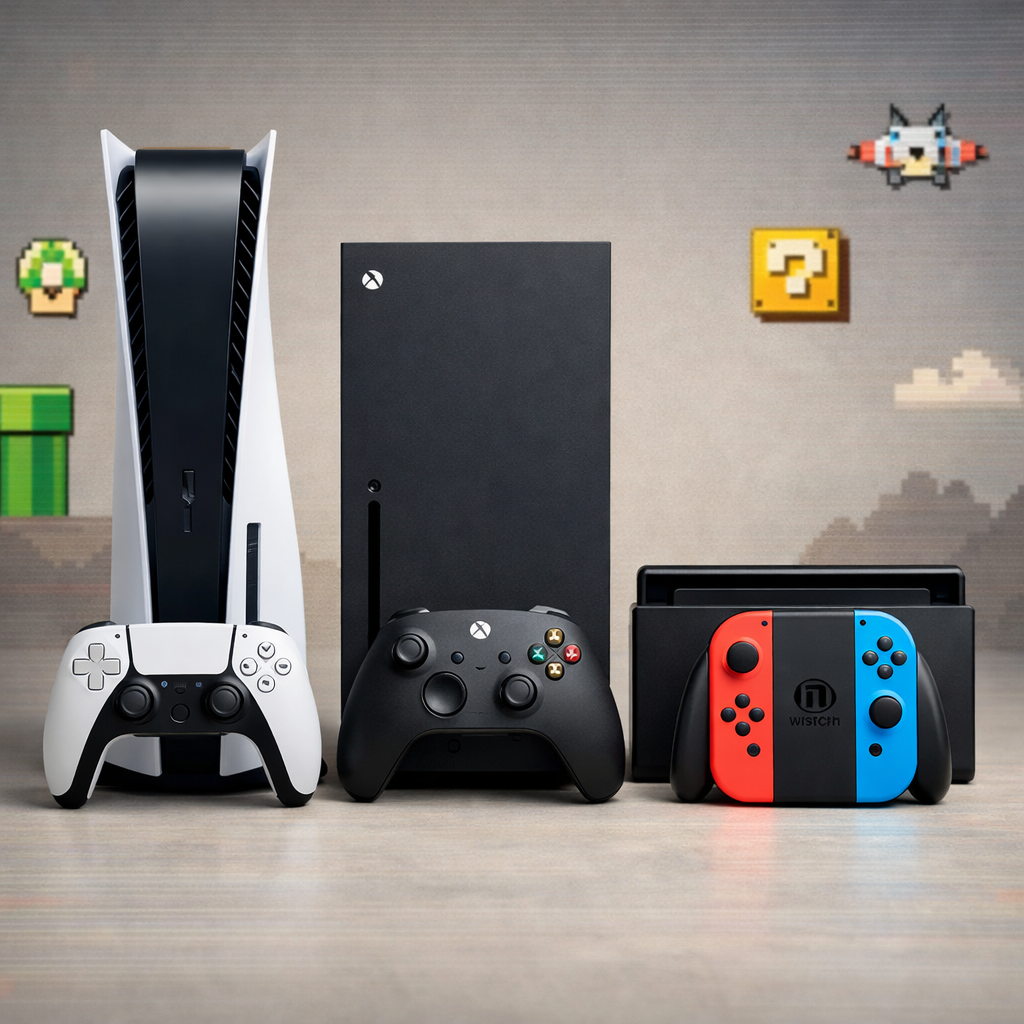
Best Gaming Console 2026: PS5, Xbox Series X, Switch Compared
Whether you’re chasing 4K spectacle, a big back catalog, or family-friendly fun, the best gaming console in 2026 depends on what you value most. For cinematic single-player exclusives and immersive feel, PlayStation 5 stands out. For raw performance, backward compatibility, and subscription value, Xbox Series X is tough to beat. For portable play and effortless couch co‑op, Nintendo Switch remains the hybrid champion. Below, we compare PS5 vs Xbox Series X vs Nintendo Switch across power, load times, controllers, ecosystems, and price—so you can pick with confidence.
Quick verdict
There’s no single “best gaming console”—match your pick to your priorities. As a rule of thumb backed by cross‑platform testing, PS5 excels at single‑player exclusives and controller immersion; Xbox Series X wins on power, backward compatibility, and Game Pass value; Switch rules portability and local play (Tom’s Guide’s cross‑platform comparison).
- “PS5 delivers near‑instant loads.”
- “Series X is the most powerful.”
- “Switch is the hybrid you can play anywhere.”
How we compare consoles
At Retro Gaming Blog, we evaluate six criteria that matter to different players:
- Graphics/performance: 4K targets, 120fps modes, and hardware ray tracing
- Load times: NVMe SSD speeds and real‑world transitions
- Controllers/haptics: precision, feedback, and comfort
- Backward compatibility: library carryover and enhancements
- Ecosystem/value: subscriptions, storefronts, and cross‑buy
- Portability/local multiplayer: hybrid play and instant co‑op
Backward compatibility means a console can play games from earlier generations—often with enhancements like higher frame rates or resolution—so your legacy library still works. This preserves collections, saves money, and makes revisiting classics easy. We also weight backward compatibility and library preservation heavily.
For context on capabilities and buyer trade‑offs, see TechRadar’s head‑to‑head breakdown of current consoles (TechRadar’s comparison).
| Console | Key Strength | Who It’s For | Notable Trade‑offs |
|---|---|---|---|
| PS5 | Immersive exclusives, fast SSD, DualSense | Story‑driven players, showcase graphics | Large chassis; exclusives locked to platform |
| Xbox Series X | Top raw performance, widest backward compatibility, Game Pass | Power users, multi‑platform libraries, value seekers | Fewer must‑have exclusives historically; AA batteries in pad by default |
| Nintendo Switch | Hybrid portability and local play; stellar first‑party | Families, travel, party games | Lowest power; many games 30fps and lower resolutions |
Who each console is for
- PS5: Best for cinematic single‑player exclusives, haptic immersion, and fast loads.
- Xbox Series X: Best for multi‑platform power, legacy libraries, and Game Pass value.
- Switch: Best for on‑the‑go play, family/local multiplayer, and Nintendo first‑party hits.
If you prioritize X, choose Y:
- Exclusives and immersion → PS5
- Value and backward compatibility → Xbox Series X
- Portability and family co‑op → Nintendo Switch
- Highest frame rates and 4K fidelity → Xbox Series X
- Fastest load times → PS5
PlayStation 5
Sony’s PS5 pairs a custom ultra‑fast SSD with strong first‑party studios to deliver polished, cinematic experiences that feel great in hand. It supports 4K output, 120fps modes in select titles, and hardware ray tracing. The DualSense controller’s adaptive triggers and nuanced haptics add tactile context—from bowstring tension to weather rumble—making the console’s sensory package a standout.
Strengths and limitations
Strengths:
- Near‑instant load times via custom SSD
- DualSense immersion with adaptive triggers and refined haptics
- Marquee single‑player exclusives with high production values
Limitations:
- Large chassis and variable cadence of exclusives
- Exclusives are platform‑locked; controller size comfort varies by hand
Specs callouts for context: 8‑core Zen 2 CPU (up to ~3.5GHz), RDNA 2 GPU (~10.3 TFLOPS), and 16GB GDDR6 RAM (see IGN’s consolidated spec chart: IGN’s PS5 vs Series X chart).
Key exclusives and experiences
The big draws include series like God of War, The Last of Us, Horizon, Marvel’s Spider‑Man, and Ratchet & Clank. These games often showcase adaptive triggers and positional 3D audio to heighten set pieces, from precise recoil to environmental detail.
Exclusives to sample first:
- Marvel’s Spider‑Man 2
- God of War Ragnarök
- Ratchet & Clank: Rift Apart
- Horizon Forbidden West
- The Last of Us Part I
Controller and immersion
The DualSense adds adaptive triggers and high‑resolution haptic feedback, plus a built‑in mic and USB‑C charging. Haptic feedback uses precise vibrations to simulate textures, impacts, and tension in your hands. Tiny actuators create nuanced sensations—from raindrops to recoil—so gameplay feels more lifelike without distracting from control. Pair that with the console’s 3D audio engine and a crisp 4K UI, and PS5’s sensory layer feels bespoke to each game.
Xbox Series X
Xbox Series X is the power, compatibility, and value leader. It’s built around a fast PCIe Gen4 NVMe SSD, runs a huge slice of the Xbox back catalog (often with boosts), and pairs beautifully with Game Pass for low‑friction discovery and family budgets.
Strengths and limitations
Strengths:
- Top raw performance in the console space
- Industry‑leading backward compatibility across generations
- Excellent value via Game Pass library access
- More compact and quieter than PS5, which helps smaller living rooms (What Hi‑Fi’s feature comparison)
Limitations:
- Historically fewer must‑have exclusives than PS5
- Controller uses AA batteries by default
Backward compatibility and value
Series X plays many Xbox One, Xbox 360, and original Xbox games—often with higher resolutions, steadier frame rates, or Auto HDR. Game Pass is a monthly subscription that unlocks a rotating library of hundreds of games, including day‑one first‑party titles on supported tiers. It reduces upfront costs, simplifies discovery, and lets households sample more genres without buying every release.
Value stack to try:
- Forza Horizon 5 (current‑gen showpiece)
- Fallout 3/4 and Gears of War (enhanced legacy)
- Sea of Thieves and Halo: The Master Chief Collection (co‑op staples)
Performance and media features
Microsoft rates Series X at ~12 TFLOPS with 52 RDNA 2 compute units and an 8‑core Zen 2 CPU up to 3.8GHz, backed by a Gen4 NVMe SSD. Expect 4K gameplay, optional 120fps modes at lower resolutions, and living‑room niceties like Dolby support and smooth streaming (see TechRadar’s best‑consoles overview: TechRadar’s best consoles). Pricing context: Series X $499; Series S $299.
Nintendo Switch
Switch is the hybrid that docks to your TV or plays handheld, making it uniquely flexible for families and travelers. In handheld, 720p is common; docked, many games target ~1080p. It can’t match PS5/Series X fidelity, but its first‑party library and local co‑op are unmatched for accessible fun.
Strengths and limitations
Strengths:
- True portability with instant pick‑up‑and‑play
- Detachable controllers and frictionless local co‑op
- Iconic Nintendo first‑party franchises
Limitations:
- Oldest and least powerful of the three
- Lower fidelity and frame rates; many docked titles at 30fps, 720p handheld
Portability and local play
Detachable controllers enable two‑player co‑op right out of the box. On a plane, train, or couch, setup is second‑nature: pop off Joy‑Cons, prop the kickstand, and pass a pad. Travel‑friendly genres include platformers, puzzle games, and party titles; prefer battery‑sipping picks that don’t push constant 3D load.
First‑party library and family appeal
First‑party titles are games built and published by the console maker’s own studios—optimized for the hardware, culturally defining, and often evergreen sellers. On Switch, that means The Legend of Zelda: Breath of the Wild, Super Mario Odyssey, Animal Crossing: New Horizons, Mario Kart 8 Deluxe, and Splatoon.
Starter library for families:
- Mario Kart 8 Deluxe
- Super Mario Bros. Wonder
- Animal Crossing: New Horizons
- Nintendo Switch Sports
Graphics and performance
PS5 and Series X both target 4K with optional ray tracing and can reach up to 120fps in performance modes at lower resolutions. Xbox holds a slight edge in raw compute, while PS5 often wins on load times thanks to its custom SSD. Switch prioritizes battery life and hybrid convenience, with 720p handheld and ~1080p docked targets.
| Category | PS5 | Xbox Series X | Nintendo Switch |
|---|---|---|---|
| Resolution Targets | Up to 4K | Up to 4K | 720p handheld / ~1080p docked |
| Frame Rate Modes | 60–120fps modes in select titles | 60–120fps modes in select titles | Often 30fps in demanding games |
| Ray Tracing | Supported in select games | Supported in select games | Not supported |
| Storage Type | Custom NVMe SSD | PCIe Gen4 NVMe SSD | eMMC/Cartridge |
| Typical Load Times | Very short, near‑instant in many titles | Very short, close to PS5 | Longer than PS5/Series X |
Controllers and audio
- PS5 DualSense adds adaptive triggers, nuanced haptics, a built‑in mic, and USB‑C charging; some find it large for smaller hands.
- Xbox Wireless Controller emphasizes reliable ergonomics and low latency; AA batteries by default but rechargeable packs exist.
- PS5’s 3D audio engine enhances positional cues over compatible headsets; Series X hardware runs cool and quiet in most living rooms.
For a consolidated look at controller features and platform specs, see the high‑level side‑by‑side in IGN’s PS5 vs Series X spec chart.
Backward compatibility and ecosystems
Xbox leads backward compatibility, spanning multiple generations, and pairs it with Game Pass for broad access and low upfront cost. PS5 supports a vast PS4 library and selective remasters, but doesn’t reach as deep into older generations as Xbox.
A gaming ecosystem is a connected set of services, libraries, accessories, saves, and friends lists that follow you as you upgrade hardware. Strong ecosystems protect purchases, simplify subscriptions, and keep your community intact—vital for households and collectors planning multiple consoles over time.
Portability and local multiplayer
Switch’s hybrid design makes it easiest to gather and play anywhere: detachable controllers, a kickstand for tabletop, and instant suspend/resume. That matters for families and travel because setup friction stays near zero.
Simple 3‑step flow:
- Dock for TV nights
- Undock for handheld commutes
- Tabletop mode for parties
Party‑friendly genres across platforms: kart racers, rhythm games, Jackbox‑style trivia, arcade beat‑’em‑ups, sports, and twin‑stick shooters.
Pros and cons at a glance
| Console | Pros | Cons | Ideal For |
|---|---|---|---|
| PS5 | Stellar exclusives, DualSense immersion, very fast SSD | Large form factor, exclusives cadence varies | Story‑driven players, showcase graphics |
| Xbox Series X | Top raw performance, best backward compatibility, Game Pass value | Fewer must‑have exclusives historically, AA batteries in controller | Power users, big backlogs, value seekers |
| Nintendo Switch | Unmatched portability and local play, iconic first‑party | Dated hardware limits fidelity/frame rate | Families, travel, casual party sessions |
Buying advice and pricing
Bottom line: pick PS5 for cinematic exclusives and tactile immersion; Series X for multi‑platform power, legacy libraries, and subscription value; Switch for portability and family play. Price snapshots for context: PS5 $499, PS5 Digital $399 at launch; PS5 Pro $699 with optional attachable disc drive around $79; Series X $499; Series S $299 (see Tom’s Guide’s pricing comparison). Also factor where your friends play, which exclusives you want, and your room’s space/quiet needs.
Retro Gaming Blog perspective
Preservation matters. Xbox’s deep backward compatibility and PS5’s broad PS4 support keep collections alive and make rediscovering classics simple. For families, stacking these libraries with modern hits extends value across generations. We also love living‑room setups that respect old and new—whether that’s a CRT corner or clean HDMI upscaling—so your history sits beside your now.
Frequently asked questions
Which console has the best performance and graphics?
The top two current‑gen systems target 4K with ray tracing and can reach up to 120fps; one has a small edge in raw power, while another often wins on load times and polished first‑party performance. For up‑to‑date comparisons, see Retro Gaming Blog’s console guides.
Which loads games the fastest?
Among current‑gen boxes, the model with a custom high‑throughput SSD typically loads fastest, with the other flagship close behind; hybrid handhelds prioritize portability over speed. We summarize load‑time trends in our guides on Retro Gaming Blog.
Which has the best exclusives and value for money?
Blockbuster single‑player exclusives are strongest on the cinematic‑focused platform, while overall value leans to the ecosystem with deep backward compatibility and a rotating subscription library. Choose the library and friends list you’ll actually use; Retro Gaming Blog breaks down the trade‑offs.
Which is best for portability and family play?
The hybrid handheld/console is the top pick for portable play and local multiplayer thanks to detachable controllers. Its first‑party games are accessible and family‑friendly for living‑room or on‑the‑go sessions.
Should I wait for hardware refreshes or buy now?
If you need a console now, buy around your top priority—exclusives, power, or portability. If you can wait for bundles or price moves, you may find better value; Retro Gaming Blog tracks notable updates in our console hub.
Explore more from Retro Gaming Blog
- Browse our continually updated console guides and comparisons: Consoles hub
- Collecting on your mind? Start with evergreen systems that hold value: Retro consoles that still hold their value
Community memories and how to reach us
We want your stories: first console memories, favorite couch co‑op nights, or a mod you’re proud of. Tell us your pick and why—your notes may feature in our next Collecting or Retro Culture round‑up.