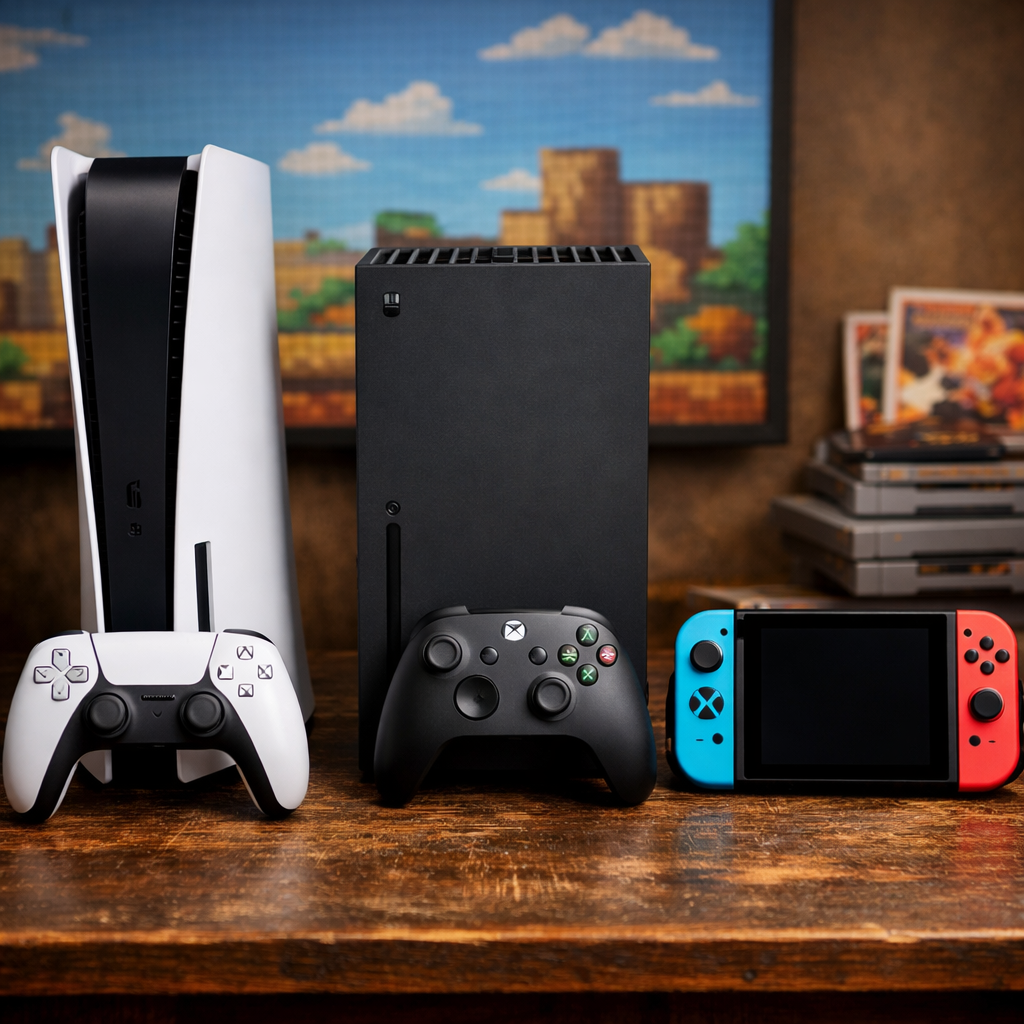
Best Gaming Console for You: PS5, Xbox Series X, Switch Compared
If you’re asking which gaming console should I buy in 2026, the answer starts with how you play. For cinematic, story-driven exclusives with next‑gen immersion, PS5 is the safe bet. If you want the best gaming console 2026 for variety and long‑term value, Xbox Series X paired with a subscription is hard to beat. For portability, family play, and evergreen Nintendo charm, the Switch remains a uniquely fun pick. Below, we cut through specs to match PS5 vs Xbox Series X vs Switch to your budget, game taste, and living room—grounded in performance realities, backward compatibility, storage planning, and long‑term ownership, the way we evaluate consoles at Retro Gaming Blog.
How to choose the right console
Use this 30‑second flow:
- Do you prioritize exclusives and immersion? Pick PS5 for polished, cinematic single‑player epics and standout controller feel.
- Do you want maximum variety and strong backward compatibility? Pick Xbox Series X for top value through subscriptions and legacy support.
- Need portability and family‑friendly local co‑op? Pick Nintendo Switch for hybrid play that fits every age.
For most multiplatform games, real‑world performance between PS5 and Series X is often indistinguishable—so your choice hinges on games, services, and form factor, not raw teraflops, as shown in TechRadar’s side‑by‑side testing (4K/60 and quick loads are common on both) TechRadar’s PS5 vs Series X comparison.
Decision snapshot:
| If you prioritize… | Pick | Why |
|---|---|---|
| Cinematic exclusives and immersion | PS5 | Elite first‑party hits + advanced haptics deliver a “next‑gen” feel |
| Variety and long‑term value | Xbox Series X | Deep subscription catalog + broad backward compatibility |
| Portability and family play | Nintendo Switch | Hybrid handheld/TV design and Nintendo’s evergreen library |
For a deeper console buying guide, keep reading.
What matters most: games, value, portability
Your daily enjoyment—and total spend—come down to three pillars:
- Games and exclusives: PS5 is worth the splurge if you live for narrative blockbusters and pristine presentation; it shines in cinematic, single‑player adventures (reinforced by mainstream comparisons).
- Value and subscriptions: Xbox Series X offers standout long‑term value thanks to a deep subscription catalog and broad compatibility for revisiting what you already own (summarized in this quick shopping guide) console buying pointers.
- Portability and family: Switch excels for all‑ages play, effortless local multiplayer, and nostalgia‑rich series—great for budget‑first buyers who want fun anywhere.
Value, defined:
Value balances upfront price, subscription access, and long‑term costs like storage, extra controllers, and repairs. It’s not the cheapest sticker—it’s what you’ll actually spend over years to play what you love, including savings from backward‑compatible catalogs and regular sales.
Quick self‑check: Score each pillar from 1–5 (Games, Value, Portability), total your scores by console, and pick the leader.
Performance and visuals
Teraflops measure raw GPU compute. Higher numbers suggest more potential, but engines, optimization, and ultra‑fast storage often equalize what you see on screen—hence many PS5 and Series X games look and run similarly.
Key facts you’ll notice in play:
- Xbox Series X supports up to 8K output and 4K at 120Hz, with 1TB NVMe SSD and 16GB GDDR6 RAM (capability headroom for the latest TVs) Tom’s Guide’s console comparison.
- Xbox delivers roughly 12 TFLOPS vs PS5’s ~10.28 TFLOPS; CPU clocks are about 3.8GHz vs 3.5GHz, while PS5’s SSD design yields blistering load times that often match or beat Xbox in practice What Hi‑Fi’s spec comparison.
- Both PS5 and Series X commonly target 4K/60 with optional ray tracing; next‑gen SSDs slash load times compared with last gen (as hands‑on testing repeatedly shows) TechRadar’s PS5 vs Series X comparison.
- Switch targets 720p handheld and 1080p docked, with many titles at 30fps—trading raw fidelity for portability Tom’s Guide’s console comparison.
Comparison at a glance:
| Console | Typical resolution targets | Common frame‑rate modes | Built‑in storage | Video features |
|---|---|---|---|---|
| PS5 | Up to 4K (some 120Hz modes) | 60fps targets; RT modes vary | 825GB (launch), 1TB (Slim) NVMe | HDMI 2.1, 4K120, VRR on supported TVs |
| Xbox Series X | Up to 8K; 4K120 capable | 60fps targets; RT modes vary | 1TB NVMe | HDMI 2.1, 4K120, VRR |
| Nintendo Switch | 720p handheld / 1080p docked | Many at 30fps | 32–64GB flash (model‑dependent) | HDMI (docked), no 4K/VRR |
Game libraries and exclusives
- PlayStation 5: Built for immersion with cinematic single‑player franchises—think God of War and Marvel’s Spider‑Man—with top‑tier audiovisual polish.
- Xbox Series X: First‑party anchors plus a deep subscription ecosystem, including major RPGs and shooters; great for variety seekers and discovery.
- Nintendo Switch: Nintendo‑first hits (Mario, Zelda, Animal Crossing) and family‑friendly favorites with a healthy indie scene and nostalgia pull.
By genre, where each tends to shine:
- Action‑adventure: PS5, Switch (Nintendo’s first‑party magic), Xbox (multiplatform standouts)
- RPG: Xbox (broad catalog via subscription), PS5 (prestige JRPGs), Switch (portable classics)
- Indie: Switch (portable convenience), PS5/Xbox (performance modes, frequent sales)
- Local multiplayer: Switch first, then PS5/Xbox
- Platformers: Switch leads; PS5/Xbox for multiplatform favorites
- Retro compilations: Switch (curated classics), Xbox (wider backward‑compatible set), PS5 (remasters/collections)
Services and subscriptions
What is a game subscription service?
A monthly plan with a rotating catalog you can download or stream. It lowers upfront costs and encourages discovery, sometimes replacing individual purchases—though favorites can rotate out. Value scales with your playtime and whether you typically buy new releases at launch.
How they differ:
- Xbox Game Pass: Creates exceptional long‑term value and the best option for variety and back catalog exploration (a core reason many pick Series X).
- PlayStation Plus (tiers): Complements PS5’s strong exclusives with classic catalogs and online access; great if you buy-and-keep big first‑party games and sample the rest.
- Nintendo Switch Online + Expansion Pack: Lower hardware cost helps entry, but many first‑party games hold price longer, affecting long‑term spend.
Pros and cons by service:
- Game Pass
- Pros: Huge rotating library; day‑one first‑party; strong backward‑compatible selection.
- Cons: Rotation means favorites can leave; adds up if you barely play monthly.
- PlayStation Plus (Essential/Extra/Premium)
- Pros: Online access; growing catalog; classic and trial options complement exclusives.
- Cons: Day‑one first‑party is rare; tiers can be confusing.
- Nintendo Switch Online (NSO)
- Pros: Affordable online; NES/SNES/N64/Genesis classics via Expansion Pack.
- Cons: Online features vary by game; modern releases hold price longer.
Who saves most?
- Heavy sampler: Series X + Game Pass usually wins on cost per hour.
- Single‑franchise buyer: PS5 or Switch can be cheaper long‑term if you mainly purchase a few exclusives to own and replay.
Backward compatibility and retro access
Backward compatibility explained:
The ability to play older‑generation games on new hardware. It preserves your library, saves money by reusing discs/digital purchases, and keeps classics alive. Support varies by system, format (disc vs digital), and which past generations are included.
At Retro Gaming Blog, we weigh backward compatibility and classic access heavily because they preserve collections and stretch budgets.
Breadth and approach:
- Xbox Series X: The most comprehensive backward compatibility of the three, spanning select original Xbox and 360 titles plus native Xbox One support (a win for preservation and value) Tom’s Guide’s console comparison.
- PS5: Backward compatibility largely covers PS4 titles, including most discs and digital purchases; older gens rely on remasters or curated streaming/classics.
- Switch: No disc legacy; retro access comes via Nintendo Switch Online’s classic libraries and publisher compilations—nostalgia‑driven and curated.
Compatibility snapshot:
| System | Supported generations | Disc support | Digital carryover | Notable retro access |
|---|---|---|---|---|
| Xbox Series X | Original Xbox/360 (select), Xbox One | Yes (where supported) | Yes | Curated BC library; classic collections |
| PS5 | PS4 (broad) | Yes | Yes | Classics via PS Plus tiers; remasters |
| Nintendo Switch | None (native) | N/A | N/A | NSO: NES/SNES/N64/Genesis; compilations |
Controllers and user experience
Feel matters:
- PS5’s DualSense controller stands out with advanced haptics and adaptive triggers that heighten immersion for supported games Tom’s Guide’s console comparison.
- Xbox Series X is favored by many for online play and cross‑platform support, with a familiar UI that makes hopping into multiplayer quick and predictable.
- Switch is approachable for all ages, with drop‑in couch co‑op that just works.
Feature notes:
- Haptics and triggers: Best‑in‑class on PS5; subtle rumble refinements on Xbox; compact rumble in Joy‑Cons.
- Latency: All three target low‑latency modes; HDMI 2.1 + VRR on PS5/Series X help minimize stutter on compatible TVs.
- Battery type: PS5 (internal rechargeable), Xbox (AA or rechargeable kit), Switch (internal Joy‑Con/Pro Controller).
- Convenience: Instantly resume multiple suspended games on Xbox; PS5’s Activity Cards streamline jumping to objectives; Switch enables seamless handheld‑to‑TV swaps.
Storage, accessories and long-term ownership
Baseline storage:
- Xbox Series X includes a 1TB NVMe SSD; PS5 launched with 825GB and later Slim models with 1TB. Both deliver drastically faster loads than last gen, transforming everyday play What Hi‑Fi’s spec comparison.
Expansion paths:
- PS5: Standard M.2 NVMe slot (choose a heatsinked drive that meets speed specs).
- Xbox Series X: Proprietary expansion card for plug‑and‑play.
- Switch: microSD card; budget for large first‑party saves/downloads.
When to upgrade storage:
- If 2–3 modern AAA installs fill your SSD, plan expansion. Big games can exceed 100GB with patches; keep 15–20% free for updates.
Ownership checklist:
- Audit your library size and typical installs.
- Estimate concurrent games (active + evergreen).
- Pick an expansion path (M.2, expansion card, or microSD) that covers the next 2–3 years.
- Add accessories: extra controllers, charging dock, headset, HDMI 2.1 cable.
- Plan for upkeep: dust filters, safe storage, and, if you preorder often, learn to preorder games wisely to avoid FOMO and waste (see our guide: our preorder guide).
Pricing and value snapshot
MSRP and typical sale notes:
| Console | MSRP (USD) | Typical sale/bundle notes |
|---|---|---|
| Xbox Series X | $499 | Bundles often add a game or months of subscription at a discount Tom’s Guide’s console comparison |
| Xbox Series S (all‑digital) | $299 | Frequent discounts; lower power but strong budget gateway |
| PS5 (Disc) | ~$499 | Holiday bundles with a first‑party game are common Laptop Mag’s pricing overview |
| PS5 Digital Edition | ~$399–$400 | Cheaper upfront; all‑digital library |
| Nintendo Switch | $299 | Bundles often include Mario/Kart; OLED model runs higher |
| Switch Lite | ~$199–$200 | Handheld‑only; great secondary or travel unit |
Note: Regional bundles and holiday offers can meaningfully change effective price and value (watch local deal trackers and regional bundle guides) bundle shopping notes.
PlayStation 5
Strengths
For immersion‑first players, PS5 delivers polished single‑player epics that feel worth the splurge, powered by stellar first‑party support and the DualSense’s nuanced haptics and adaptive triggers. Many titles hit 4K/60 with ray tracing options and dramatically faster loads than last gen, elevating the “just one more chapter” effect.
Trade-offs
On paper, PS5 trails Series X slightly in raw GPU TFLOPS and CPU clocks, though real‑world parity is common in multiplatform games. Backward compatibility is largely limited to PS4 titles. Storage on the original 825GB model fills quickly; Slim revisions improve this to 1TB.
Best for
- Story‑first solo adventurers and trophy hunters who want pristine, cinematic experiences.
- Home theater setups targeting 4K/60 visuals and immersive controller feedback.
- Players who buy and keep exclusives rather than rotate through a subscription catalog.
Xbox Series X
Strengths
If you value breadth and long‑term savings, Series X is the variety champion—its subscription ecosystem and the most comprehensive backward compatibility of the trio unlock a huge playable library. It also posts the highest headline specs, including ~12 TFLOPS GPU, 1TB NVMe SSD, and 4K/120‑capable output.
Trade-offs
Despite its spec lead, visual output commonly ties PS5 in multiplatform games. Sales performance has lagged in certain regions in recent years—market chatter more than gameplay impact—but it can influence community size for some titles Den of Geek’s 2023 market recap. Note: the all‑digital Series S is cheaper but less powerful; align expectations.
Best for
- Subscription‑first samplers who want a steady stream of new games.
- Retro library explorers who prioritize robust backward compatibility.
- Online multiplayer regulars who appreciate straightforward cross‑play.
Nintendo Switch
Strengths
Switch is the timeless fun‑first hybrid: handheld on the go, docked at home, and instantly welcoming to every age. Nintendo’s evergreen franchises anchor family nights and nostalgia‑driven sessions, and the hardware’s lower entry price makes it an easy second console.
Trade-offs
It’s underpowered next to PS5/Series X—expect 720p handheld/1080p docked with many games at 30fps. First‑party titles keep their price longer, which shapes long‑term budgets. Online features and backward compatibility lean on curated classic libraries rather than system‑wide support.
Best for
- Families, couch co‑op fans, and quick‑session players who want portability.
- Anyone chasing Nintendo exclusives and retro‑flavored comfort games.
- Budget‑conscious buyers who value flexible play locations over raw fidelity.
Verdict and recommendations by player type
- Story‑first soloist → PS5. You’ll feel the difference in exclusives and the DualSense’s immersion.
- Value‑sampler → Xbox Series X. Subscription catalog + backward compatibility maximize variety per dollar.
- Family/local co‑op → Switch. Hybrid design and all‑ages franchises make setup and play effortless.
- Home‑theater purist → PS5 or Series X. Both deliver near‑parity 4K/60; choose by controller feel and services (tests show minor differences in practice).
- Retro library explorer → Xbox Series X. Broad compatibility and curated classics keep your history alive.
- Budget starter → Switch Lite or Series S. Great entry points—just note Lite is handheld‑only and Series S targets 1440p with lower power.
Final tip: If you’re torn, choose by the exclusives you can’t miss this year.
Frequently asked questions
Which console has the best graphics and frame rates?
The latest 4K‑capable consoles deliver near‑identical high‑end visuals, often targeting 4K/60 with ray tracing; differences are usually minor. At Retro Gaming Blog, we suggest choosing by games and services over small spec gaps.
Which is better for families and local multiplayer?
A hybrid handheld‑TV system with family‑friendly exclusives is the easiest for all ages and excels at local multiplayer. Retro Gaming Blog typically points families to that route for effortless shared play.
What offers the best long-term value?
A high‑end console paired with a robust subscription usually wins on variety per dollar; buying and replaying a few exclusives can also be cost‑effective. Retro Gaming Blog breaks down total cost of ownership by how you play.
How important is backward compatibility for classic games?
If you own older libraries or love classics, broad backward compatibility is a big deal; some systems rely on curated retro collections instead. It’s a key factor in our picks at Retro Gaming Blog.
Should I wait for sales or bundles?
Yes—seasonal bundles and regional offers can meaningfully lower effective cost. If your timing is flexible, Retro Gaming Blog generally advises waiting.