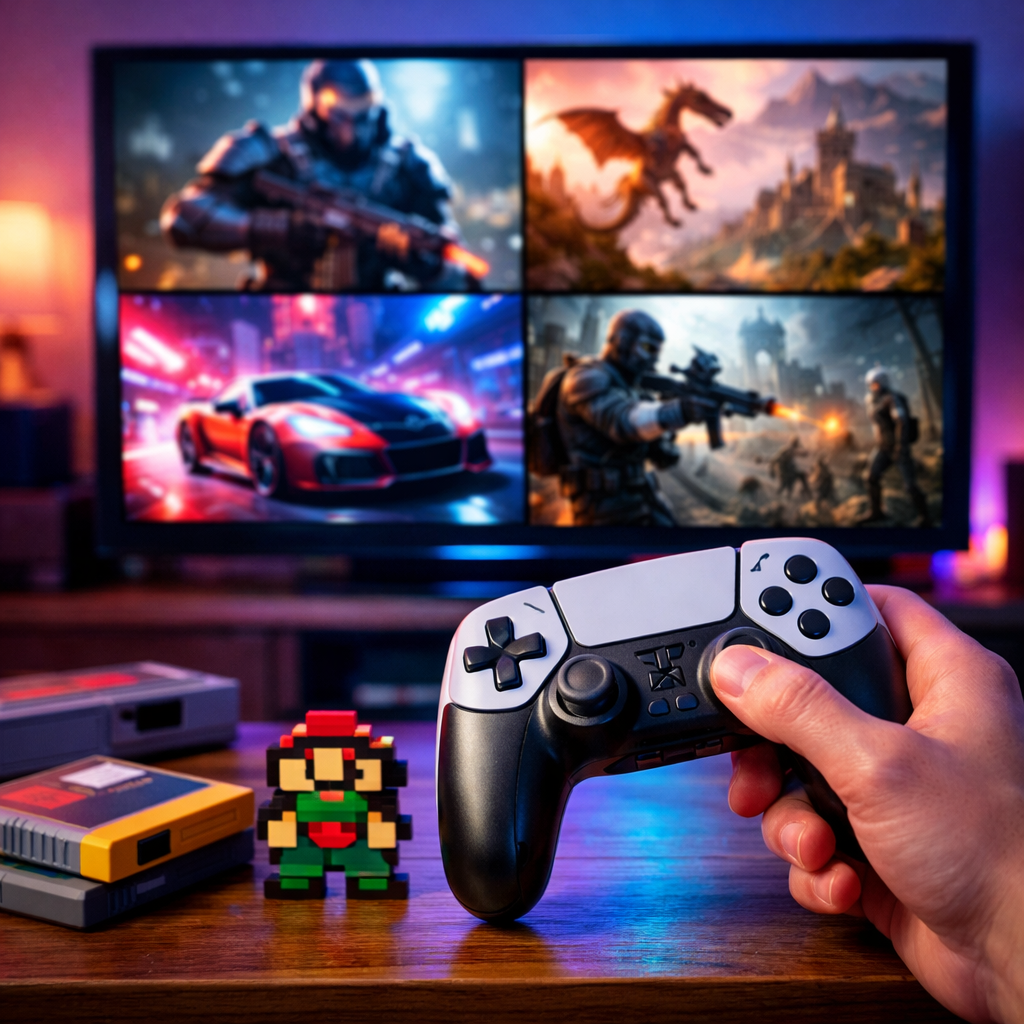
Hottest Games of 2026: What Everyone’s Playing Right Now
From big-budget survival horror to meditative life sims, 2026 is a year of sharp contrasts—and that’s exactly why these releases are dominating playtime. The current hot games in the gaming world split cleanly between combat-first systems that reward mastery and restorative loops that value comfort, craft, and routine. Platform choices and tiered pricing matter more than ever, and performance optimization is the new value yardstick. Below, we map the best games of 2026 across genres and platforms with the same retro-informed lens we bring to CRTs, RGB, and input lag—so you can decide what to play now and what to prep your setup for next.
Who’s hot right now: Resident Evil Requiem; Pokémon Pokopia; Mewgenics; Nioh 3; Cairn; Perfect Tides: Station to Station; Big Hops; Grand Theft Auto VI (watchlist).
Strategic Overview
This year’s slate is defined by breadth: precision combat and resource tension on one track, cozy creativity and gentle progression on the other. You can feel the split in storefront charts and reviews—action-forward pillars like Requiem and Nioh 3 sit alongside low-stress hits such as Pokopia and Perfect Tides, with roguelike tinker toys (Mewgenics) and focused survival (Cairn) bridging the gap. It’s also a year of platform specialization and clear price/performance trade-offs: $70 standards and $90 deluxe tiers anchor AAA, while performance modes and PC parts costs now drive buying calculus as much as content, a throughline you’ll see echoed across roundups like GameSpot’s best games of 2026 feature (GameSpot: 2026 best games roundup). We weigh each pick through performance stability, input latency, and display readability—the stuff that actually changes how they feel to play.
Retro Gaming Blog
Our stance: knowledgeable, nostalgic, and practical. We connect ’90s design lessons—clear silhouettes, tight loops, honest difficulty—to today’s releases, and we get hands-on with the hardware that makes them sing. Expect analysis that moves between Sega Saturn-era complexity and modern VRR scalers, with a preservation-first mindset. If you’re new here, our deep dive on why the ’90s were gaming’s golden age (Retro Gaming Blog: 1990s design deep dive) sets the tone, and our Saturn repair primer (Retro Gaming Blog: Sega Saturn reflow guide) shows the level of tool-centered detail we love. Share your own display chains, RGB mods, and controller swaps in the comments—we feature standout setups in future roundups.
Resident Evil Requiem
Requiem is 2026’s headline act: an 89 Metacritic average and 90 on OpenCritic, with reports of 5 million units shipped in days after its February 27 launch (The National: 2026 releases snapshot). CBR’s mid-year roundup also places it near the top of the year’s best, citing pacing and tension as key strengths (CBR: 2026 best-so-far list). Built on Capcom’s RE Engine for PC, PS5, Xbox Series X|S, and Switch 2, it launches at $70 for standard and $90 for a Deluxe Steelbook, ESRB M17+ for intense violence and strong language (PCMag: 2026 release & platform guide).
Survival horror is a design style emphasizing vulnerability, resource scarcity, and tension-building through limited visibility, deliberate pacing, and high-stakes encounters. It prioritizes dread and decision-making over power fantasies, often using fixed or constrained camera/readability cues to guide players.
What retro fans will love:
- Camera discipline reminiscent of classic entries, punctuated by RE4-style action beats.
- Inventory/resource pressure that echoes late-’90s survival-horror values.
- A great testbed to compare modern haptics with classic digital-pad inputs or zero-deadzone sticks.
Pokémon Pokopia
Pokopia widens 2026’s appeal with a cozy, real-time life sim built around weather, collection, and social loops—and absolutely no combat. Released March 5 on the Nintendo Store for Switch, it’s holding steady around 88 on Metacritic according to regional roundups (The National: 2026 releases snapshot). CBR’s curation highlights its gentle cadence and readable UI as major draws for short, mindful sessions (CBR: 2026 best-so-far list).
A cozy game is a low-stress genre focused on gentle goals, creative expression, and routine-building. Progress comes from crafting, collection, and social/ambient loops rather than high-stakes failure—ideal for short sessions and mindful play.
Retro resonance:
- Day/night cycles and seasonal events that feel like classic handheld sims.
- Clean, readable interfaces with big iconography and consistent affordances.
- Mechanical clarity that rewards habit-forming routines over grind.
Mewgenics
If Requiem is the big tent, Mewgenics is the tinkerer’s lab—praised for deep systems, chaotic runs, and a generational meta that rewards iteration (GameSpot: 2026 best games roundup; The National: 2026 releases snapshot). It’s a strategy-driven roguelike about raising and fielding generations of unusual cats, with meta-progression that meaningfully reshapes each attempt.
A roguelike is a run-based structure with procedural generation, permadeath, and meta-progression. Each attempt reshuffles challenges and loot, encouraging experimentation and mastery through short, high-variance sessions.
Quick build paths to try:
| Build path | Traits to chase | Early-game tip |
|---|---|---|
| Bruiser lineage | High base HP, stun-on-crit | Prioritize crowd control over raw damage for safer clears. |
| Hexer lineage | Status stacking, DoT amplifiers | Draft at least one cleanse to countercurse late waves. |
| Breeder lineage | Fertility boosts, lineage perks | Bank weak but trait-rich cats for next-gen synergies. |
| Scout lineage | Evasion, initiative spikes | Open with positioning perks to dictate the first turn. |
Nioh 3
Team Ninja’s third entry refines its Souls-like combat with more open-field exploration and meticulous frame tuning—launching February 6, 2026 on PlayStation and PC to strong praise for its timing windows and route variety (LSU Reveille: 2026 action ratings; GameSpot: 2026 best games roundup).
A Souls-like is an action-RPG built around precise stamina combat, pattern learning, and punishing-but-fair difficulty. It emphasizes readable telegraphs, route-shortcuts, and boss mastery over stat inflation.
Controller and camera tips for consistent parries:
- Map parry to a face button if you struggle with shoulder timing; keep dodge on a distinct finger.
- Lower camera sensitivity 10–15% to stabilize lock-on drift during multi-foe fights.
- Use a short deadzone and linear response curve to tighten micro-corrections.
- Enable a subtle camera recenter on sprint to keep boss tells centered.
Cairn
Cairn turns mountaineering into a gripping survival loop—route planning, weather reads, and tool economy over brute strength. With an 85 Metacritic average in early tallies, it’s become 2026’s “quietly tense” pick for players who love planning as much as action (The National: 2026 releases snapshot).
A survival game centers on managing resources (warmth, stamina, tools), risk assessment, and route planning. Success depends on preparation and environmental literacy more than raw combat skill.
Checklist for safer ascents:
- Layering matters: pack light-mid shells plus an emergency thermal.
- Rope/anchor economy: overpack nuts; place anchors conservatively on exposure.
- Weather reads: watch barometer drops and lenticular cloud build-up before committing.
Perfect Tides: Station to Station
This intimate sequel leans into character choice, hand-drawn framing, and consequence—ideal for players who crave ’90s adventure pacing and story-first design. Early reception clusters around 86, with nods to its art and branching relationships (The National: 2026 releases snapshot).
A narrative adventure is a story-led game prioritizing dialogue, branching decisions, and environmental detail. Challenge often comes from social puzzles and consequence management rather than reflex tests.
Pull-quotes and themes:
- “Small choices echo the loudest when the world isn’t shouting.”
- “Hand-drawn margins make inner lives feel annotated, not explained.”
- “Relationships drift like trains—momentum matters more than speed.”
Standout (spoiler-light) choice moments:
- Whether to keep a difficult letter unsent—and what that silence costs later.
- Picking whose version of an event you memorialize in a zine scene.
- Taking an awkward detour to repair a friendship before the final station.
Big Hops
Big Hops is 2026’s feel-good 3D platformer: clean silhouettes, readable routes, generous checkpoints, and movement that’s fun before it’s fast. Available on PC, PS5, and Switch, it’s consistently praised for charm and accessibility in roundups (GameSpot: 2026 best games roundup).
A 3D platformer is a jump-and-move genre emphasizing spatial navigation, collectible routes, and camera-assisted readability. The best entries balance momentum, silhouette clarity, and forgiving recoveries.
What to compare as you start:
- Movement tech: dash cancel → double-jump routes; wall-kick consistency.
- Level readability: color-coded rails and shadow blobs under jumps.
- Speedrun practice worlds: early “Toybox Terrace” for routing, midgame “Sky Candy Isles” for momentum chains.
Grand Theft Auto VI
2026’s cultural event is set for November 19 on PS5, Xbox Series X|S, and PC, with every systems talk tying back to open-world lineage and how far simulation can scale (TechRadar: most anticipated 2026 games).
Pre-release watchlist:
- AI traffic density and pedestrian schedules that feel lived-in.
- Police logic escalation and de-escalation loops.
- Radio curation that anchors place and time without repetition fatigue.
- Performance modes and streaming stability during high-speed traversal.
Mini-glossary:
- Draw distance: how far world detail renders before popping.
- Streaming: background loading of assets as you move; stutter = streaming bottlenecks.
- Population density: number of active NPCs/vehicles simulated per area.
Why these games resonate with retro fans
Reviews consistently frame a contrast: tight combat systems (Requiem, Nioh 3, Mewgenics) versus restorative or creative loops (Pokopia, Perfect Tides), a balance that mirrors cartridge-era clarity (GameSpot: 2026 best games roundup; The National: 2026 releases snapshot). The retro-aligned traits are easy to spot—fixed-resource tension, reset-friendly runs, clean silhouettes, and short-session compatibility.
If you liked these ’90s classics, try these 2026 games:
- Resident Evil 2 (1998) → Resident Evil Requiem
- Harvest Moon GB → Pokémon Pokopia
- Diablo (1996) challenge runs → Mewgenics
- Tenchu → Nioh 3
- SkiFree/Alone in the Dark resource nerves → Cairn
- Broken Sword → Perfect Tides: Station to Station
- Spyro/Super Mario 64 worlds → Big Hops
Nostalgia checkpoints and homages to classic design
Resident Evil Requiem
- Ribbon-adjacent save tension and scarcity echo late-’90s survival horror.
- Door transition cuts used as beat markers and streaming masks.
- UI glyphs and map grids readable at a glance, CRT-era style.
Big Hops
- Mascot-era color coding on hazards and collectibles.
- Chunky silhouette clarity for both hero and enemies.
- Pause-screen “manual” tips that read like condensed instruction booklets.
Perfect Tides: Station to Station
- Hand-drawn panels that recall adventure game box art and zine culture.
- Cursor hotspots that glow subtly, not loudly—like VGA-era points of interest.
- Journal margins with doodles that function as diegetic hint systems.
Tip: label your screenshots with “readability beats” (silhouette checks, shadow blobs, directional arrows) to see how each game telegraphs information cleanly.
Performance, pricing, and platform notes
Pricing signals: $70 is now the AAA baseline, with deluxe editions commonly at $90; tiered pricing is expanding across both purchases and subscriptions in 2026 (BCG: 2026 gaming industry report). On PC, optimization expectations are rising—16GB of VRAM is increasingly the bare minimum for stable 4K textures, and DDR5 supply swings may nudge build prices upward, as recent technical breakdowns and market chatter underscore (YouTube: PC performance headroom explainer). We prioritize stable frame pacing and low latency over raw resolution—a familiar tradeoff for retro-minded setups.
Quick buyer’s table (typical targets and value picks):
| Title | Platforms | Common performance modes | Storage footprint (typ.) | Editions | Best value |
|---|---|---|---|---|---|
| Resident Evil Requiem | PC, PS5, Series X | S, Switch 2 | 60fps perf / 30fps quality; VRR on PS5/XSX | 50–70GB | Std $70; Deluxe Steelbook $90 |
| Pokémon Pokopia | Switch | 30fps target; handheld-optimized | 10–15GB | Standard | Single-tier is fine. |
| Mewgenics | PC, PS5, Series X | S, Switch | 60fps baseline | 5–10GB | Standard; OST bundle on PC |
| Nioh 3 | PC, PS5 | 60fps perf / 120fps on capable PCs | 70–90GB | Std; Deluxe with cosmetics/OST | Standard unless you want cosmetics. |
| Cairn | PC, PS5, Series X | S | 60fps target; 30fps quality mode on consoles | 20–30GB | Standard |
| Perfect Tides: Station to Station | PC, Switch | 60fps (lightweight) | 5–8GB | Standard | Standard. |
| Big Hops | PC, PS5, Switch | 60fps on PS5/PC; 30–60 on Switch | 12–20GB | Standard | Standard. |
| Grand Theft Auto VI | PC, PS5, Series X | S | 30/60fps modes; VRR expected | 100GB+ | Std $70; Deluxe $90 (typ.) |
How modern hits echo ’90s lessons in pacing and readability
Requiem’s resource stress mirrors late-’90s survival pacing: you plan every room like a puzzle, not a shooting gallery.
Nioh 3’s tell-heavy combat honors arcade readability, letting animation timing—not stat bloat—drive mastery.
Pokopia’s loops channel handheld session design: 15-minute windows that accumulate meaning over weeks, not grinds.
Readability is the ease with which players parse on-screen information via clear silhouettes, consistent UI language, and predictable enemy telegraphs. High readability reduces cognitive load, improves fairness perception, and enables faster mastery without verbose tutorials—one of the most durable lessons from the cartridge/CD era.
Share your loadouts, mods, and memories
We want to see your blend of old and new:
- Your favorite Requiem loadouts (knife-first minimalism? Magnum-last?) or Nioh 3 builds (stance/runes that click).
- Display chains for low-latency play: scalers, VRR settings, and RGB comparisons against original hardware.
- Memories of ’90s play that these 2026 games rekindled.
From our benches: one editor beat Requiem’s first act on a CRT via HDMI-to-RGB, measuring a ~1 frame input gain over a laggier flat panel. Another finally nailed Nioh 3 parries after switching to a Saturn-style pad with a crisp D-pad roll.
Frequently asked questions
What makes a game feel ‘retro’ even when it’s new?
Clear rules, readable visuals, and deliberate pacing create that throwback feel—even with modern tech. At Retro Gaming Blog, we spotlight modern games that use those limits well.
Are the hottest games of 2026 worth it on base editions or should I buy deluxe tiers?
Base editions usually provide the full core experience. Retro Gaming Blog typically recommends deluxe tiers only if you value early access, cosmetics, or soundtrack/art bonuses.
How can I reduce input lag and get accurate color on modern displays?
Use Game Mode, disable extra post-processing, and enable VRR if available—our Retro Gaming Blog display tips start there. Calibrate with a test pattern, then set brightness/gamma; a good HDMI 2.1 cable and locking your frame rate to a stable target also help.
Which 2026 games are best for short sessions on a busy schedule?
Pokémon Pokopia’s cozy loops and Mewgenics’ run-based structure fit 15–30 minute windows, and Big Hops’ checkpointed stages work great too—see Retro Gaming Blog’s quick-session picks for more.
Do any of these games work well with classic-style controllers or arcade sticks?
Nioh 3 and Mewgenics benefit from precise D-pad inputs, and many 2D-friendly pads or arcade sticks map cleanly. Retro Gaming Blog also covers simple controller mappings, and Big Hops plays well on retro-style controllers thanks to readable inputs.