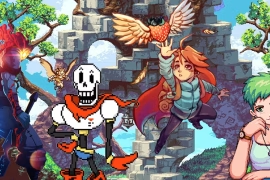
The indie gaming scene is one of the most exciting parts of the video game industry today. Every year, we see dozens of small teams, or even solo developers, release games that break expectations, challenge conventions, and sometimes even outshine the big-budget AAA titles. It’s a revolution that feels fresh, but when you look closely, there’s a beating heart of nostalgia in the middle of it. The truth is, if you want to understand modern indie games, you have to look back. You have to look at the pixelated, bleeping, side-scrolling past. That’s where it all began. That’s how retro gaming influenced modern indie games.
Walking through today’s digital stores, it’s impossible to miss how many indie titles proudly wear their 8-bit or 16-bit influences on their sleeves. The pixel art, chiptune soundtracks, and tight gameplay mechanics aren’t just aesthetic choices, they’re love letters to an era that helped shape everything we know about interactive entertainment.
Simplicity That Spoke Volumes
One of the main ways retro gaming influenced modern indie games is in the way gameplay is approached. Many of the best old-school titles had to do more with less. They didn’t have the luxury of expansive budgets, motion capture, or complex narrative tools. What they had were tight mechanics, responsive controls, and level design that encouraged experimentation and mastery.
Think about Mega Man, Contra, or Castlevania. These games didn’t need photorealism to keep you coming back. They were brutally fair, designed with precision, and rewarding in ways that modern indies still strive for. Fast forward to today and you’ll see games like Celeste, Shovel Knight, or The Messenger that build on these foundations. The mechanics are responsive, every jump matters, every enemy is placed with purpose.
It’s no coincidence that some of the most successful indie games emphasize gameplay over flash. Retro titles taught developers that polish and fun don’t come from size, they come from focus.
Aesthetic Inspiration from the Pixel Era
The pixel art style wasn’t always a trend. It was born from necessity. Developers on early consoles like the NES or SNES had limited color palettes, tiny resolutions, and strict hardware limitations. But in working within those boundaries, they created an aesthetic that still resonates today.
Modern indie games have brought that visual language back in a big way. Whether it’s Hyper Light Drifter with its atmospheric, neon-drenched pixel world, or Undertale with its simple but expressive sprites, these games tap into the same visual charm that defined the 8-bit and 16-bit generations.
The reason pixel art remains so beloved is that it leaves room for imagination. A few flickering pixels can suggest a whole world, a whole character. There’s beauty in that abstraction. And there’s also a practicality, many indie developers are working with limited resources, and pixel art allows for manageable production while still delivering a distinct, emotionally resonant style.
It’s easy to see how retro gaming influenced modern indie games just by looking at the screen. But there’s more to it than visual flair.
Sound Design Rooted in Chiptune Culture
Before high-fidelity audio became standard, games had to get creative with sound. The bleeps and bloops of retro titles were more than placeholders, they became iconic. Who doesn’t immediately recognize the coin sound from Super Mario Bros. or the opening theme of The Legend of Zelda?
Today, many indie games deliberately embrace chiptune soundtracks, not only to channel nostalgia but to recreate that sense of emotional simplicity. Games like Fez, Katana ZERO, and VVVVVV use electronic sounds and lo-fi melodies to create mood and identity in ways that echo the classics.
There’s something haunting and pure about a great chiptune score. It sticks with you. It pulses in your head long after the game is done. That power didn’t vanish when CD-quality sound came around, it just evolved.
When you hear a catchy 8-bit riff in a new game today, you’re not just hearing a nod to the past. You’re hearing a continuation of an artistic tradition that retro gaming pioneered and indie developers keep alive.
Level Design and Player Discovery
Another vital way retro gaming influenced modern indie games is through the approach to level design. In many classic games, discovery was key. You weren’t guided by arrows or hand-holding tutorials. Instead, you had to explore, fail, and learn. That sense of curiosity and trial-and-error was part of the appeal.
Indie developers have embraced this idea. Games like Hollow Knight, Axiom Verge, and Spelunky don’t walk you through every step. They drop you in and let you figure it out. That sense of empowerment, of earning your knowledge, mirrors the old days of trying to find hidden blocks in Super Mario Bros. or deciphering cryptic paths in Metroid.
These games reward curiosity and patience, just like their retro ancestors. And the satisfaction of discovering something on your own hasn’t diminished, it might be more valuable than ever.
Storytelling Through Mechanics
Retro games didn’t always have complex plots, but they told stories through gameplay. The narrative wasn’t always spelled out, it was felt. The slow unraveling of Metroid, the escalating pressure of Tetris, the urgent pacing of Ninja Gaiden, these games immersed you in emotion through interaction.
Modern indie developers understand this power. Games like Limbo or Inside barely use words at all, yet they tell devastating, rich stories just through atmosphere and control. Others, like Papers, Please, use mechanics themselves to deliver the emotional punch.
This method of “show, don’t tell” comes straight from the limitations of retro gaming. In the absence of cutscenes, voice acting, or detailed dialogue trees, developers had to tell their stories with action. That ethos hasn’t just survived, it’s thriving in the indie world.
Empowerment of Solo and Small-Team Development
One of the most direct connections between retro and indie games is in how they’re made. Many legendary retro titles were created by small teams, sometimes even by one or two people. That DIY spirit is core to the indie world.
Back then, games like Cave Story or Doom were built by passionate individuals who wanted to share their vision. Today, developers like Toby Fox (Undertale) and Eric Barone (Stardew Valley) have taken up that mantle.
This is where the heart of how retro gaming influenced modern indie games beats strongest. The tools have evolved, the distribution methods have changed, but the drive is the same: build something great, make people feel something, and do it your way.
Influential Mechanics That Still Resonate
Many gameplay mechanics we take for granted today were pioneered by retro games. Save points, power-ups, permadeath, level-ups, inventory management, combo systems, these weren’t born in the age of 3D realism. They came from limitations that forced creativity.
Modern indie games continue to borrow, refine, and innovate on these mechanics. Dead Cells and Hades modernized the roguelike. Cuphead turned boss rushes into an art form. Streets of Rage 4 resurrected the beat-’em-up with polish and reverence.
By embracing these mechanics instead of abandoning them, indie developers honor the past while keeping it relevant. They understand that old-school doesn’t mean outdated, it means foundational.
Risk-Taking and Creative Freedom
Retro games weren’t afraid to be weird. You had games about plumbers in mushroom kingdoms, ghosts eating power pellets, frogs crossing highways, and blobs transforming into bubbles. They were wild, experimental, and imaginative.
That same risk-taking spirit drives the best indie games today. Whether it’s the dreamlike exploration of Journey, the genre-bending gameplay of Baba Is You, or the musical storytelling of Wandersong, indie developers feel empowered to try strange ideas because retro games proved that weird can work.
This creative freedom is another key reason why retro gaming influenced modern indie games. The past showed that you don’t have to play it safe to make something special. You just have to believe in your vision and be brave enough to share it.
Distribution and Access
Back in the ’80s and ’90s, game developers relied on publishers and physical distribution to get their games into players’ hands. It was expensive, risky, and often out of reach for small teams. But indie developers now have the digital marketplace, and it mirrors the spirit of those early days when a simple cartridge could change everything.
Platforms like Steam, itch.io, and the Nintendo eShop have given creators the same kind of access to audiences that old arcade cabinets or NES cartridges once offered. You don’t need a massive ad campaign. You just need a good game, a little luck, and the courage to put it out there.
Retro gaming was all about accessibility. Anyone could walk into an arcade and try something new. Anyone could pick up a controller and dive in. Today’s indies, inspired by that openness, continue the tradition.
Community and Legacy
One of the most beautiful ways retro gaming influenced modern indie games is in the way community plays a role. Many indie developers grew up playing the classics. They’re fans just like us. And their games are often love letters not just to the mechanics or visuals, but to the experience of being a player.
There’s a dialogue between generations happening. Fans of Metroid will recognize the DNA in Axiom Verge. EarthBound lovers feel right at home in Undertale. Zelda fans explore the worlds of Tunic with wide eyes and wonder.
These games don’t just copy the past, they communicate with it. They build on it. They celebrate it.
And they remind us that the games we grew up with still matter, not just because of nostalgia, but because they helped define the language of play.
Conclusion
The indie game renaissance didn’t appear out of thin air. It was built on decades of experimentation, imagination, and design lessons first written in the 8-bit and 16-bit eras. When people ask how retro gaming influenced modern indie games, they’re really asking how today’s most creative developers learned to think outside the box, embrace simplicity, and focus on fun.
It’s no accident that the best indie games often feel like they could have existed in the cartridge age, if only the technology had been ready. They don’t just imitate retro games. They inherit their spirit.
In the end, what makes indie games so powerful today is the same thing that made retro games unforgettable: heart. A belief in the magic of games. A desire to create something personal. And a dedication to making the player feel something real.
That’s the lasting legacy of how retro gaming influenced modern indie games. It’s a bridge between past and future. And it’s a reminder that sometimes, the best way forward is to remember where it all began.