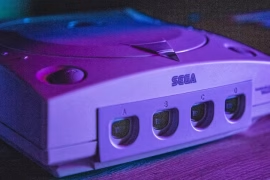
The Sega Dreamcast didn’t just mark the end of Sega’s console-making era, it marked the beginning of a new age in gaming. For many of us who grew up in the late ’90s, the Dreamcast was more than just a console; it was a revolution. Whether it was the online capabilities, the quirky but forward-thinking controller, or the sheer ambition of its library, there’s no denying how the Sega Dreamcast changed gaming forever.
It may not have had the longest shelf life, and it may have been overshadowed by the PlayStation 2’s massive success, but the impact it left behind still ripples through modern gaming. If you peel back the layers of current-gen consoles and online multiplayer, you’ll find a blueprint that Sega drew up back in 1999.
Launching Into the Future
The Dreamcast launched in North America on September 9, 1999, a date seared into memory with its 9/9/99 marketing campaign. With a retail price of $199, it undercut its competition while offering advanced technology. The hardware was ahead of its time: a 128-bit console capable of rendering 3D graphics that made the PlayStation and Nintendo 64 look like relics.
But it wasn’t just about visuals. The Dreamcast came packed with features that would shape the future of gaming, including a built-in modem for online play and an innovative Visual Memory Unit (VMU) that gave players a portable, interactive memory card. Even the interface design was clean, modern, and customizable, setting a tone that future consoles would follow.
Looking back, it’s easy to see how the Sega Dreamcast changed gaming forever just through the choices made in its launch and design. Sega was clearly aiming to do something bold and different, and it succeeded.
Introducing Online Console Gaming
For me, one of the defining elements of the Dreamcast was its online capability. In 1999, online console gaming was basically unheard of. Sure, the PC world had been deep into it with games like Quake and Ultima Online, but for consoles, this was a bold leap.
The Dreamcast’s built-in 56K modem was groundbreaking. No extra hardware was needed, just plug it into a phone line, sign up for SegaNet, and you were ready to go. Titles like Phantasy Star Online brought MMORPG elements to a living room couch, letting players team up, explore dungeons, and battle monsters in real-time.
It wasn’t just an experiment; it was a vision of things to come. Xbox Live, PlayStation Network, and Nintendo Online all owe something to what Sega pioneered with Dreamcast. That first taste of online play on a console changed how players saw multiplayer, it was no longer about splitting the screen but connecting across the world.
This, more than anything else, is a reason why I say how the Sega Dreamcast changed gaming forever. It set the groundwork for the digital and connected age we now take for granted.
Game Library That Pushed Boundaries
Despite its relatively short lifespan, the Dreamcast delivered an impressive and diverse game library. It wasn’t afraid to take risks, which led to some of the most unique and experimental titles of the era.
Games like Jet Set Radio introduced cel-shaded graphics that would later influence titles like The Legend of Zelda: Wind Waker and Okami. Shenmue created a living, breathing world years before sandbox games became the norm, with a day-night cycle, NPC schedules, and open-ended exploration.
Even arcade ports were unmatched. Soul Calibur wasn’t just good, it was better than its arcade counterpart. Crazy Taxi and Marvel vs. Capcom 2 brought arcade energy into the living room with stunning fidelity.
Then there were the oddballs, Seaman, where you spoke into a microphone to care for a sarcastic fish-man hybrid. Only on Dreamcast would something so weird and innovative be possible. The console embraced creativity and boldness, pushing the envelope at every turn.
All of this fed into how the Sega Dreamcast changed gaming forever, it expanded what was possible, dared to try the unexpected, and proved that consoles didn’t have to play it safe.
The Visual Memory Unit: A Glimpse at Portable Integration
The VMU deserves its own spotlight. On the surface, it was a memory card with a screen, but it quickly became one of the most innovative accessories in gaming history. You could play mini-games on it, view secret information during gameplay, or carry your save data to a friend’s house.
In Sonic Adventure, for example, you could raise Chao creatures and transfer them to your VMU for training on the go. In fighting games, you could view your health or execute secret inputs without your opponent seeing.
It was a precursor to second-screen gaming and mobile connectivity. Years later, the Wii U and Switch would explore similar ideas, but the Dreamcast had already laid the groundwork. That’s part of the reason why I strongly believe how the Sega Dreamcast changed gaming forever, it didn’t just offer new ways to play, it expanded how we interacted with games themselves.
Arcade-Quality Ports and Sega’s Arcade Legacy
Sega had been a juggernaut in the arcade scene, and it brought that legacy to the Dreamcast in full force. The console’s architecture was based on Sega’s NAOMI arcade system, which meant that ports of arcade games were nearly perfect.
Games like Virtua Tennis, House of the Dead 2, and Daytona USA brought arcade-level excitement straight into the home. No other console at the time could match the sheer adrenaline and graphical fidelity that the Dreamcast offered.
For those of us who spent our afternoons feeding quarters into arcade machines, having those same experiences at home without compromise felt unreal. The Dreamcast made the impossible possible, and in doing so, made console gaming a true competitor to arcades.
Homebrew and Independent Development
After Sega exited the hardware market, the Dreamcast refused to die. Its open architecture made it a favorite among hobbyists and homebrew developers. Even now, new games are still being made and released for the console. From indie platformers to shoot-em-ups, the Dreamcast community remains incredibly active.
The console used standard GD-ROMs but could also read MIL-CDs, which allowed creative coders to boot their own programs. It became a playground for experimentation and underground development long before indie games became mainstream.
This openness contributed in another subtle way to how the Sega Dreamcast changed gaming forever, it empowered players and coders to take control, create, and distribute their own content. That spirit of independence is something we now see everywhere in today’s indie gaming scene.
Marketing and Missteps
Despite all the innovation, the Dreamcast faced serious challenges. Sega had lost goodwill with players after the failure of hardware like the Sega CD and Saturn. When the Dreamcast launched, it had to overcome that baggage.
The 9/9/99 launch was successful, but the shadow of the PlayStation 2 loomed large. Sony’s promises of DVD playback and backwards compatibility made the Dreamcast look limited by comparison. Even though the PS2’s launch library was weak, the brand power carried it far.
Then there was the issue of third-party support. While the Dreamcast had solid titles, it struggled to secure consistent backing from big publishers. EA famously skipped the platform entirely, which meant no Madden, FIFA, or Need for Speed. That hurt.
Eventually, with mounting losses and the looming threat of the PS2 juggernaut, Sega made the heartbreaking decision to bow out. But what they left behind wasn’t a failure, it was a system that had done more in two years than some consoles manage in a decade.
Cult Following and Legacy
Even now, the Dreamcast commands love and respect. It has one of the most devoted fanbases in retro gaming. Collectors still seek out its rare titles, and modders continue to find new ways to extend its life, whether it’s through HDMI mods, SD card loaders, or custom VMUs.
The games, the hardware, the innovations, all of it feels fresh even today. When I boot up Skies of Arcadia or Power Stone, it’s not nostalgia I’m chasing; it’s a return to a time when gaming felt wide open and full of creative possibility.
When we talk about how the Sega Dreamcast changed gaming forever, it’s not just about the technology. It’s about the attitude. The boldness. The willingness to try something weird and different.
Looking at Today’s Consoles Through a Dreamcast Lens
It’s amazing how many elements from the Dreamcast now feel standard. Online gaming, digital peripherals, memory cards with extra functionality, arcade-level graphics at home, and open development tools, these are all things the Dreamcast did early.
Even some of the biggest developers today got their start on the system. Visual Concepts, which made NFL 2K, is now the studio behind the NBA 2K franchise. The ideas from Shenmue laid the foundation for open-world adventures like Yakuza. Jet Set Radio’s unique art style influenced a generation of cel-shaded titles.
Without the Dreamcast, gaming would still have arrived where it is today, but it would have taken longer. And it might have lacked the eccentric, passionate spirit that Sega poured into its last console.
Final Thoughts
When I think about how the Sega Dreamcast changed gaming forever, I don’t see it through rose-colored glasses. I see it as a brave console that dared to be different in a world that often punishes risk. It didn’t succeed commercially, but it succeeded in pushing the industry forward in a dozen important ways.
It gave us online play, it gave us genre-defying games, and it gave us a vision of what gaming could be. It lit a fire that other companies followed, and even now, it inspires gamers, developers, and collectors around the world.
The Dreamcast may be gone, but its legacy is eternal, and for anyone who picked up that chunky white controller and logged onto SegaNet, it’s impossible to forget just how ahead of its time it really was.