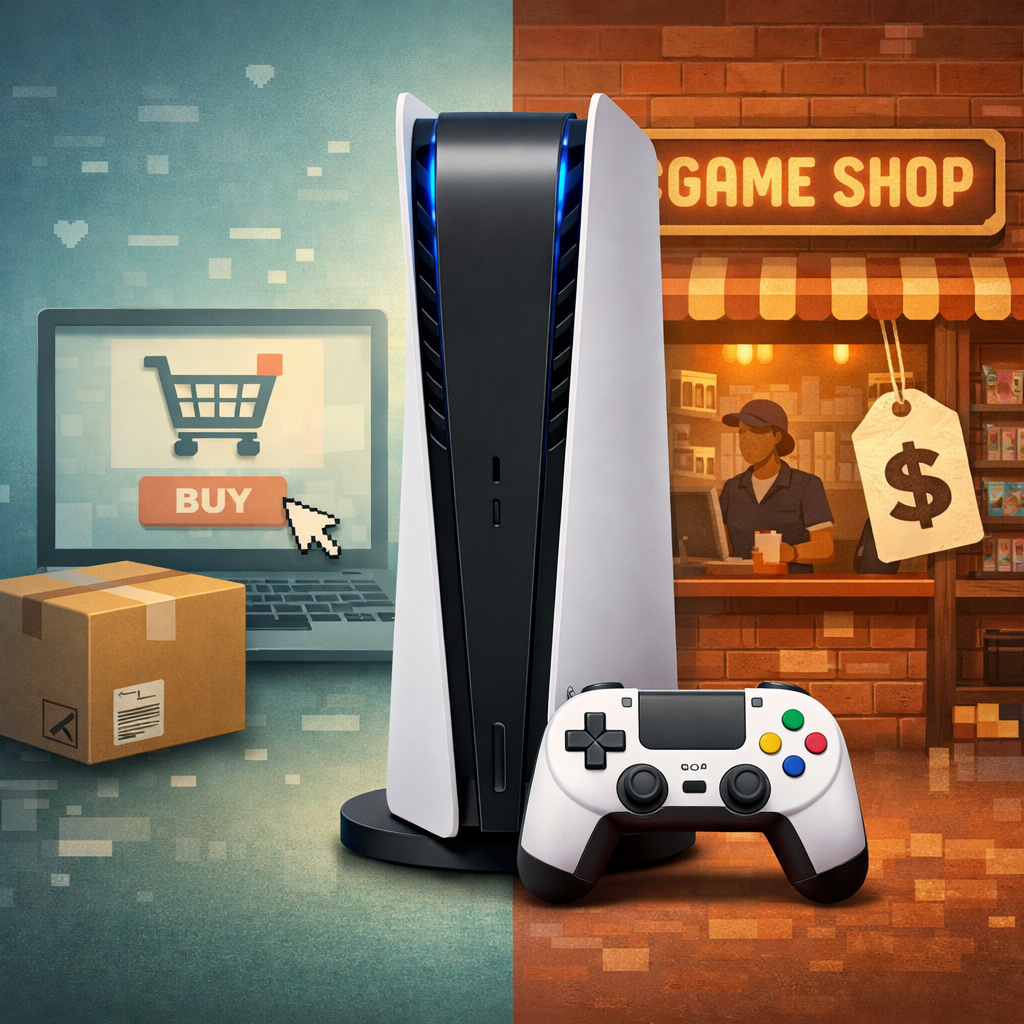
Retailer Comparison: Online vs. Local for 2025’s Top Console
Deciding where to buy 2025’s top-rated console comes down to tradeoffs: online retailers usually win on selection, price agility, and consolidated reviews; local stores win on immediate pickup, hands‑on inspection, and human support. If you want the lowest price and widest choice, shop online. If you want same‑day play, box condition checks, and straightforward exchanges, go local. Either way, lean on review behavior—more than 7 in 10 consumers read online reviews when researching local businesses, and many won’t buy without them—per widely cited online review statistics. Retro Gaming Blog’s buying guides cover both paths so you can move fast without guesswork.
How to choose where to buy
Online shines for breadth, dynamic pricing, stock alerts, and aggregated reviews. Local excels at in‑store pickup, condition verification, and trust built through face‑to‑face service. According to online review statistics, 71%+ of shoppers consult reviews for local businesses, making digital vetting essential even before walking into a store.
Use this quick route by priority:
- Lowest price: Start with online marketplaces and brand stores; set cross‑site price alerts.
- Fastest pickup: Call nearby shops for holds; use map listings for hours and stock notes.
- Easiest returns: Favor local stores for same‑day exchanges; review return windows at checkout.
- Best trade‑in value: Ask local specialty shops about credit multipliers and bundle stacking.
Definition — Dynamic pricing (≈45 words): Dynamic pricing is the automated adjustment of list prices based on real-time demand, competitor moves, and inventory signals. For retailers to stay competitive, “product and pricing data should be delivered to retailers’ systems every 20–30 minutes,” with actions typically taken within two hours of collection (Competera’s analysis).
What matters most when buying the top console
Price transparency, availability/restocks, reviews/social proof, shipping/returns, and trade‑ins/bundles are the five pillars for 2025. Shoppers triangulate decisions across multiple feedback sources; 62% consult two to three review sites before buying, and 55% only consider businesses with 4+ stars, per leading online review statistics.
What you value → Best channel
- Lowest price → Online (marketplaces, brand stores, flash promos)
- Instant play/testing → Local (same‑day pickup, demo units)
- Hassle‑free exchanges → Local (face‑to‑face resolution)
- Deep bundle variety → Online (digital games, loyalty promos)
- Verified box condition/serial → Local (inspect before purchase)
“Social proof” (≈46 words): Social proof is the tendency to rely on others’ experiences—ratings, reviews, and community signals—when making a purchase. Because 62% read 2–3 review sites and 55% prefer 4+ star ratings, strong, recent, and verified reviews reduce risk on big-ticket console buys (per online review statistics).
Online retailers
Online channels excel at choice, pricing agility, and aggregated trust signals. Retailers often reprice rapidly—competitive data should be delivered every 20–30 minutes and acted on within two hours—to stay sharp during launches and promo cycles (Competera’s analysis). To capitalize, set price alerts and use price monitoring tools; Retro Gaming Blog explains practical alert setups, and industry roundups note solutions like Price2Spy can even track competitors that try to block scraping (Symson’s pricing tools overview).
Selection and pricing dynamics
Dynamic pricing drives volatility—prices can shift within hours during peak demand. Effective repricing depends on fresh inputs; “product and pricing data should be delivered…every 20–30 minutes” to inform timely moves (Competera’s analysis).
How to catch deals:
- Set alerts on two or three marketplaces.
- Compare bundles vs. console‑only.
- Check included games/subscriptions against what you’ll use.
- Re‑check cart totals before checkout for last‑minute dips.
Competitive pricing thrives where transparency is high (retail/ecommerce), enabling rapid undercutting and bundle experimentation. Tool realities vary: some platforms require custom algorithm design to match your goals, while pre‑defined features can be limiting for complex use cases (Symson’s pricing tools overview).
Reviews and social proof
Key signals online: 71%+ read reviews before trying a business; 62% check two or three sites; 55% want 4+ stars; and 83% use Google for local reviews, per online review statistics. In our buyer guides at Retro Gaming Blog, we weight recent, verified, hardware‑specific reviews more heavily.
A quick review framework:
- Scan rating trends over time, not just the average.
- Filter for verified purchases and recent hardware‑specific comments.
- Look for seller responses—people are more likely to review when managers engage, indicating accountability.
Social proof (≈45 words): Social proof aggregates other buyers’ experiences into a confidence signal: ratings, photos, and long‑form reviews. When recent, verified, and consistent across multiple sites, these signals reduce uncertainty—especially for costly consoles and bundles—making buyers more comfortable with checkout decisions (per online review statistics).
Shipping, delivery, and return flow
Expect 1–3 day standard shipping from most major retailers, with launch‑week slowdowns. During checkout, screenshot return windows and restocking fees.
Hassle‑free returns checklist:
- Prepaid label and clear RMA flow
- Window length (14–60 days typical)
- Condition rules (opened vs. sealed)
- Refund versus store credit timeline
Online retailer comparison (examples)
- Marketplace A: 2‑day fast shipping; 30‑day returns; 0–15% restocking on opened units
- Specialty Retailer B: 3–5 days; 30–45 days; no restocking if defective on arrival
- Brand Store C: 2–4 days; 14–30 days; restocking rare but strict accessory completeness
- Big‑Box D: 1–3 days or in‑store return; 30–60 days; restocking varies by region
Bundles, add‑ons, and digital perks
Online perks often include digital game bundles, 1–3 month subscription trials, and loyalty discounts—specialist retailers curate bundles and may leverage loyalty pricing tools (Symson’s pricing tools overview). Always compare MSRP versus effective price, dividing the total discount by included items to quantify per‑accessory value. As a rule, Retro Gaming Blog uses simple effective‑price math to compare bundles.
Watch‑outs:
- Region locks on physical games/accessories
- Warranty terms for third‑party add‑ons
- DLC codes tied permanently to your account/region
Local retailers
Local stores deliver immediacy, tactile assurance, and trust—especially valuable during launch windows or for buyers who want in‑person guidance. Map‑based review integrations (think: store listings on map platforms) improve discovery and trust by surfacing reputation alongside distance and hours, strengthening local credibility (nature research on map‑based review visibility).
Immediate pickup and hands‑on inspection
Pre‑visit checklist:
- Call ahead to confirm SKU/bundle and quantities
- Ask about hold policy and deposit rules
- On arrival, inspect box seals, serial match, and accessory list
What to inspect in store
- Factory seals and tamper labels
- Serial number on box vs. console
- Controller ports and accessory pack‑ins
- Cosmetic damage on seams/panels
- Region labeling and power standards
Definition — Map-based reviews (≈46 words): Map‑based reviews are location‑anchored ratings, photos, and comments displayed inside mapping apps that rank nearby stores by relevance and reputation. This visibility can boost trust and foot traffic because shoppers discover, evaluate, and navigate in one place (nature research on map‑based review visibility).
Staff expertise and community trust
Human expertise matters: clerks can advise on compatibility, parental controls, storage needs, and durable accessories. Map‑based review ecosystems also let offline sellers collect location‑specific feedback that reinforces trust and accountability (nature research on map‑based review visibility).
Questions to ask your clerk:
- What firmware version ships on this batch?
- What’s the return/exchange window and restock cadence?
- Any preorder or trade‑in promos coming?
- Which accessories are OEM and which are reliable third‑party?
Returns, exchanges, and in‑store support
Typical local return flow:
- Bring receipt and ID.
- Staff tests the unit with you.
- Same‑day exchange or refund if eligible.
Quick contrast:
- Local: same‑day resolution, no shipping delays.
- Online: convenient initiation, but shipping + processing add time.
Caution:
- Restocking fees on opened hardware may apply.
- Opened‑software returns are often restricted.
- Holiday policies can differ from standard terms.
Trade‑ins, bundles, and local exclusives
Maximize value: estimate trade‑in credit for older consoles, stack with bundle promos, and ask about refurbishment grades for trade‑ins. Local exclusives can include limited faceplates, day‑one swag, or bonus store credit—verify authenticity and packaging condition for collector editions.
Modder’s tip:
- Ask how modifications affect warranty.
- Confirm OEM vs. third‑party parts and availability of replacements.
- Discuss safe power/thermal practices before overclocking or storage swaps.
Side‑by‑side comparison
Online vs. Local (quick view)
- Price transparency and volatility: Online uses rapid, data‑driven repricing (updates every 20–30 minutes); Local is steadier but less aggressive on flash dips (Competera’s analysis).
- Availability and restocks: Online offers nationwide alerts; Local offers per‑customer limits and in‑person stock checks (supported by map‑based review visibility research).
- After‑sales support: Online has broad, centralized policies but requires shipping; Local enables face‑to‑face troubleshooting and same‑day exchanges.
- Accessories/mods/collector appeal: Online has the widest ecosystem; Local enables condition verification and staff guidance on safe modding.
Price transparency and volatility
Definition — Dynamic pricing (≈45 words): Dynamic pricing continuously tunes prices using demand, competitor, and inventory inputs. Effective systems refresh “product and pricing data…every 20–30 minutes” and act within two hours, creating short‑lived dips buyers can capture with alerts (Competera’s analysis).
Note: Consumer tools vary—some require custom rules or algorithms; pre‑defined features can be limiting for nuanced tracking (Symson’s pricing tools overview).
Availability and restock tactics
Online:
- Set cross‑site stock alerts and follow brand/store drops.
- Use multiple review sources to validate sellers; 62% of buyers already consult 2–3 sites (per online review statistics).
Local:
- Call ahead to confirm SKUs and holds; use map listings for hours and directions.
- In‑person purchase limits help deter scalpers; visibility on maps enhances trust and quick decision‑making (nature research on map‑based review visibility).
After‑sales support and warranty ease
Warranty steps (both channels):
- Keep proof of purchase and note serial/IMEI.
- Register warranty if offered; expect 1–3 week turnaround for mail‑in service.
- For defects in week one, ask about exchange versus repair.
Local simplifies immediate exchanges and troubleshooting. Online policies are comprehensive but involve packaging, shipping, and processing time. If you prefer minimal downtime, local support usually wins.
Accessories, mods, and collector appeal
Online:
- Broader accessory ecosystems and rare peripherals; verify region compatibility and how third‑party add‑ons affect warranty.
Local:
- Inspect collector editions for box condition, seal integrity, and matching serials. Staff can advise on safe mod paths and maintenance. Retro Gaming Blog tip: cross‑check box art variants and regional serial formats to preserve collection value.
Recommendations by buyer type
Lowest price and widest choice
- Set price alerts across 2–3 major sites; re‑check carts before paying.
- Time buys for mid‑week dips and seasonal promos; transparency drives competitive pricing online (Competera’s analysis); see Retro Gaming Blog’s monthly market trends for timing cues.
- Validate seller reputation across multiple platforms—71% read reviews and 55% prefer 4+ stars (per online review statistics).
Immediate play and easy returns
- Choose in‑store pickup for same‑day play; confirm return window at checkout.
- Bring ID, check seals/serial in‑store, and test if demo stations exist.
- Use map‑based listings to confirm reviews and hours before you go (nature research on map‑based review visibility).
Collectors and modding enthusiasts
- Inspect locally for box condition, serial matching, and limited‑edition authenticity.
- For mods, buy from channels that disclose warranty impact; ask for OEM parts and known‑good accessories.
- Document purchases (receipts, photos) to preserve collection provenance.
Parents and first‑time buyers
- Favor local stores for setup guidance, durable accessory picks, and straightforward exchanges.
- Must‑buys: screen protector, extra controller, safe storage, and charging solutions; ask about parental controls.
- Read a few verified reviews—most shoppers rarely try a new business without them (per online review statistics); Retro Gaming Blog’s simple setup checklists can shorten day‑one setup.
Tips to avoid scalpers and stock shocks
- Enable retailer/app alerts; avoid third‑party markups from unauthorized sellers.
- Use in‑person limits at local stores and monitor 2–3 reputable sites; target sellers with 4+ star ratings and clear return policies (per online review statistics).
- Be patient during volatility—dynamic pricing can swing within hours due to frequent data refreshes (Competera’s analysis).
Community insights and retro culture ties
Share store tips, honest deal finds, and condition‑check photos in the comments on Retro Gaming Blog—help fellow players, parents, and collectors buy smart while preserving hardware for the long term. Box condition, original accessories, region compatibility, and preventive maintenance all impact value and longevity. For deeper dives, see our guides on Retro Gaming Blog to region‑free considerations, retro consoles that hold value, and current market trends.
- Comparing region‑free consoles for retro gaming on Retro Gaming Blog
- Retro consoles that still hold their value on Retro Gaming Blog
- Monthly retro game market trends (June 2025) on Retro Gaming Blog
Frequently asked questions
Is online or local better during launch shortages
Online typically sees more frequent restocks and broader shipping, while local stores offer same‑day pickup when stocked and may limit per‑customer quantities. Use both—set online alerts and call nearby shops for holds; Retro Gaming Blog posts timing tips during launch weeks.
Where do bundles and trade‑ins offer better value
Local stores often provide stronger trade‑in credits and in‑store bundle bonuses, while online retailers counter with digital bundles and loyalty discounts. Compare the effective price after credits and included items using simple bundle math from Retro Gaming Blog.
How do return policies differ in practice
Online returns are centralized and convenient but require shipping and processing time. Local retailers usually allow faster in‑person exchanges or refunds, which can be easier for first‑time buyers and parents; see Retro Gaming Blog’s return checklist.
What’s the best way to track real‑time stock
Set alerts across two or three major retailers and check store listings on maps for nearby availability; Retro Gaming Blog rounds up reputable alert sources. Call ahead to confirm SKU and hold policies during high‑demand windows.
Are limited editions easier to find online or locally
Online offers broader variety and faster announcements, but local shops help verify condition and authenticity in person. For collectors, in‑store inspection reduces risk, while online can be better for widespread drops; Retro Gaming Blog’s authenticity tips outline what to check.