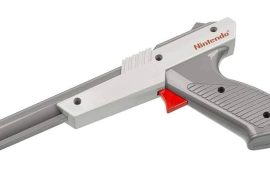
The NES Zapper is one of those iconic gaming accessories that instantly sparks a flood of memories. Whether it’s the satisfying click of the trigger or the unforgettable duck-hunting scenes flashing across a CRT screen, the Zapper played a major role in how many gamers experienced the Nintendo Entertainment System. But there’s more to this gray-and-orange light gun than just Duck Hunt and nostalgia. The story behind it involves clever engineering, arcade inspiration, and a fascinating evolution of light gun technology.
In this article, I’m diving deep into the history of the NES Zapper, how it was born, how it worked, and why it left such a lasting impact on retro gaming. This wasn’t just a cool plastic peripheral; it was a game-changer, literally.
Where It All Began
The roots of the NES Zapper actually stretch back well before the NES hit American shores. In Japan, Nintendo had been dabbling with light gun technology since the 1970s. One of the company’s early successes was a toy called the “Laser Clay Shooting System,” a light gun arcade-style shooting game installed in abandoned bowling alleys. These installations were expensive and short-lived, but they laid the groundwork for future home console accessories.
By the time the Famicom (Family Computer) launched in Japan in 1983, Nintendo already had a plan to bring light gun shooting into living rooms. The original Famicom light gun looked like a realistic revolver, with a black handle and silver barrel, totally different from the orange and gray toy most American gamers would come to know. This version of the gun was bundled with a game called Wild Gunman, which had players shooting onscreen bandits with timing and accuracy.
When Nintendo prepared to launch the NES in North America in 1985, the light gun was redesigned to fit new market standards. Due to toy gun regulations and parental concerns, it couldn’t resemble a real firearm. So Nintendo swapped the revolver design for a more sci-fi inspired blaster, giving it the now-famous gray body with an orange barrel tip. And with that, the NES Zapper was born.
How the Zapper Worked
One of the most interesting things about the history of the NES Zapper is the technology behind it. This wasn’t some kind of laser pointer or infrared beam, it relied on an optical detection method that was both simple and ingenious.
When you pulled the trigger on the Zapper, the screen would momentarily go black and flash a white square where the target was located. This happened in just a few frames, often too quickly for the human eye to notice. The Zapper’s light sensor would detect whether it was pointed at that white square. If it saw the square during the flash, the system registered a hit. If it saw nothing but black, it counted as a miss.
This method only worked with CRT televisions. Modern LCDs, LEDs, and OLEDs don’t refresh in the same way, so the Zapper can’t detect the flashes accurately. That’s one reason why this peripheral is a true relic of its time, an artifact from the era when bulky tube TVs were the norm in every living room.
Duck Hunt and the Power of Bundling
It’s impossible to talk about the history of the NES Zapper without giving Duck Hunt its due credit. While several Zapper-compatible games were released, Duck Hunt is the one that defined the experience. It was bundled with the NES Action Set, which included both Super Mario Bros. and Duck Hunt on the same cartridge.
This dual-game pack introduced countless players to two completely different gameplay styles, platforming and shooting, in one box. And for many, Duck Hunt was their first introduction to interactive aiming and shooting using physical movement.
The dog that laughed at you for missing? That became a cultural icon. The ducks flapping away just out of reach? Infuriating and addictive. The Zapper didn’t just enhance gameplay, it created a new kind of gameplay altogether, turning the television into an active shooting gallery.
Other Zapper-Compatible Games
While Duck Hunt is the most famous, the Zapper had a library of titles worth exploring. Some of them were arcade ports, while others were NES originals. A few of my personal favorites include:
- Hogan’s Alley – You shoot either bad guys or innocent civilians as they pop up on screen. Quick reflexes required.
- Wild Gunman – Based on the original Japanese version, this Western-themed duel game used full-screen character animations and timed trigger pulls.
- Gumshoe – A strange platformer/shooter hybrid where you control the character by shooting him to make him jump.
- Freedom Force – A futuristic, airport-terrorist-themed game with fast-paced shooting segments.
In total, fewer than 20 NES games were made to work with the Zapper, and only a handful are really remembered today. That’s not a huge library, but the games that worked with the Zapper delivered unique experiences you couldn’t replicate with the standard controller.
A Peripheral with Cultural Impact
The NES Zapper wasn’t just a game controller, it became part of pop culture. You’d see it in advertisements, TV shows, and even classroom discussions when people started talking about video game violence in the late ’80s and early ’90s. It symbolized the shift in gaming from simple button presses to more interactive, immersive play.
Retailers loved showcasing it in demo kiosks, and kids would crowd around to get a chance to play Duck Hunt. The bright orange barrel made it look toy-like and safe, while the clicky trigger gave it a satisfying, arcade-style feel. Holding the Zapper made you feel like you were doing something cool and high-tech, especially in an era when motion controls and VR were still distant dreams.
The history of the NES Zapper wouldn’t be complete without acknowledging how many people kept theirs long after they stopped using it. Mine still sits on a shelf next to the NES, an artifact from my early days of gaming that I just can’t part with.
Decline and Legacy
Eventually, the light gun era faded. As television technology evolved, CRTs were phased out in favor of flatscreens, which rendered the Zapper nonfunctional. Nintendo moved on to other innovations like the Super Scope for SNES, which never quite captured the same magic. Later systems like the Wii brought motion controls back into the picture, but the Zapper’s unique blend of simplicity and tactile response never returned.
Still, its legacy remains strong. Modern developers and modders have attempted to bring back Zapper-style shooting through emulation, sensor overlays, and even modified LCD-compatible guns. The retro gaming community still talks about the Zapper with reverence, and it’s a prized part of any complete NES collection.
From a historical standpoint, the Zapper proved that peripherals could redefine gameplay. It wasn’t just about pressing buttons, it was about pointing, aiming, reacting. It laid the foundation for future innovations like motion controls and VR shooting.
Collectibility and Current Value
When looking at the history of the NES Zapper through a collector’s lens, its value is relatively modest, at least for loose units. Because so many were produced, you can find them for under $20 loose, and even boxed versions rarely break the $100 mark unless they’re sealed.
That said, complete-in-box bundles with Duck Hunt and Super Mario Bros. are starting to creep up in price, especially if the packaging is in good condition. And rare alternate packaging, like the Power Set with the Power Pad, can fetch higher values.
If you’re collecting Zapper games, Duck Hunt and Hogan’s Alley are common and affordable. Games like Gumshoe and Freedom Force are a bit harder to come by in good condition, and boxed copies will cost you.
One quirky tip: be careful with display. The orange plastic can fade over time if exposed to sunlight, and the internal components can be damaged by heat and humidity. Treat it like the piece of gaming history it is.
Zapper Clones and Knockoffs
One of the lesser-known parts of the history of the NES Zapper is how many third-party companies tried to capitalize on its popularity. Various knockoff light guns hit the market during the late ‘80s and early ‘90s, often with exaggerated designs or gimmicks like recoil simulation.
These third-party Zappers were usually cheaper but less reliable. Some worked with non-Nintendo systems, others were just off-brand accessories with questionable compatibility. While they’re interesting from a collector’s perspective, they never matched the quality or iconic status of the official Zapper.
Still, if you’re hunting for unusual NES peripherals, checking out Zapper clones and third-party light guns can lead you down some very entertaining rabbit holes.
Modern Homages and Modding
Even though the original Zapper no longer works with modern TVs, fans have found ways to keep it alive. Some use Raspberry Pi or Arduino kits to convert the Zapper for use with emulators and LCD screens. Others build custom games inspired by Duck Hunt using similar mechanics.
There are even companies creating brand-new light guns that replicate the Zapper’s feel while using updated infrared or sensor bar technology. It’s a testament to how strong the nostalgia is for this quirky peripheral.
Modders have also taken to customizing Zappers with LED lighting, new paint jobs, and even functional USB adapters. It’s become a way for people to express their love for the NES era in a hands-on, creative way.
Final Thoughts
The history of the NES Zapper is more than just a chapter in Nintendo’s timeline, it’s a key moment in gaming evolution. It brought arcade-style shooting into homes, helped make the NES a cultural phenomenon, and created some of the most iconic memories in retro gaming history.
From its clever CRT-based technology to its unforgettable orange-and-gray design, the Zapper proved that video games could be more interactive, more physical, and more immersive than we’d previously imagined. Whether you played Duck Hunt obsessively or only picked one up years later at a flea market, the Zapper left an impression.
Looking back, the history of the NES Zapper is also a reminder of how innovation doesn’t always mean high-tech. Sometimes, a simple plastic light gun and a blinking screen can make magic happen.