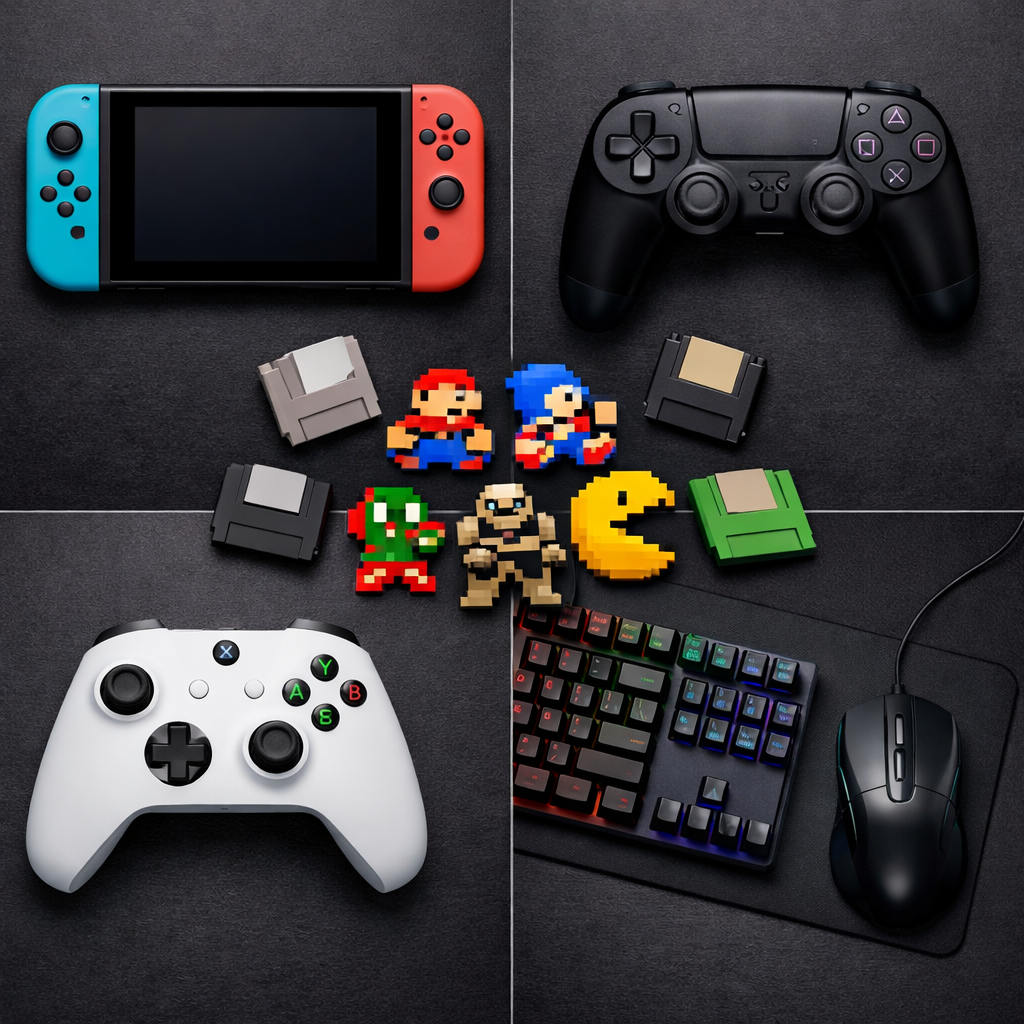
Top Classic Game Compilations Compared: Switch, PlayStation, Xbox, and PC
Classic game compilations have never been easier to buy and play—but the best platform depends on your priorities. If you want handheld nostalgia and easy couch co-op, go Switch. If you crave polished remasters on a 4K TV, lean PlayStation. For performance and backward compatibility, Xbox wins. And if you’re after flexibility, mods, and the best deals, PC is unmatched. Below, we break down how these platforms stack up on portability, performance, features, price, and availability—so you can pick the right home for your favorite retro game collections. As always at Retro Gaming Blog, we bring the perspective of lifelong enthusiasts across our pillars—Consoles, Games, Modding, Collecting, and Retro Culture.
How we evaluated classic game compilations
We define classic game compilations as curated bundles of legacy titles that add modern conveniences—then tested them across portability, performance, features, price, and availability. Hardware realities matter: Nintendo Switch renders around 720p in handheld and up to 1080p docked, setting expectations for portability versus fidelity tradeoffs, as outlined in Tom’s Guide’s console comparison. We also considered how Xbox Series X runs games at higher resolutions and framerates—useful for modernized classics—per Wirecutter’s console picks. Across expert consensus, the strengths generally break down this way: Switch for portable value, PlayStation for polish, Xbox for performance and backward compatibility, and PC for flexibility and regular deals. We also track regional availability and patch history over time to reflect the experience you can expect today.
- Tom’s Guide console comparison: portability vs. fidelity context (Switch 720p/1080p) (https://www.tomsguide.com/features/ps5-xbox-series-x-nintendo-switch-console-comparison)
- Wirecutter console guide: Series X performance headroom (https://www.nytimes.com/wirecutter/reviews/best-game-consoles/)
What counts as a classic compilation
A classic game compilation is a bundle of legacy titles—often from the same series, publisher, or platform—re-released with modern conveniences like save states, rewind, display options, and galleries. Many include quality-of-life upgrades or remasters while preserving original gameplay for authenticity.
Most retro game collections now include rewind, quick saves, music players, museum scans, and upscaling options, and many layer in remasters or optional filters. These emulation features are central to game preservation and vary in depth by publisher and platform, with PC often providing the most control and customization.
Key criteria for comparison
To help you match priorities to platform strengths, we compared compilations using the criteria below.
| Criteria | What to look for and why it matters |
|---|---|
| Portability & local multiplayer | Handheld play, drop-in co-op, and quick sessions; Switch leads for on-the-go and family setup. |
| Visual fidelity & performance | Resolution/framerate stability and clean upscaling for 4K TVs; Series X often has the highest headroom, while Switch tops out at 720p handheld/1080p docked (per Tom’s Guide). |
| Library depth & availability | Size of the catalog and where collections launch first; PC’s storefronts and bundles widen access over time. |
| Features & extras | Rewind, save states, galleries, filters, and regional variants; implementations vary by publisher. |
| Pricing & long-term value | Upfront hardware cost versus ongoing sales, bundles, and subscription access. |
PC performance varies by configuration—handheld PCs illustrate why. Tom’s Guide’s ROG Ally X review recorded roughly 16.6 FPS at 720p Ultra in a demanding modern title, ~21.9 FPS at 1080p Medium, and ~30 FPS at 1080p High, underscoring the tuning required for consistent results (https://www.tomsguide.com/gaming/handheld-gaming/rog-xbox-ally-x-review).
Nintendo Switch
Strengths for compilations
Switch thrives on pick-up-and-play design, robust local multiplayer, and portable-first sessions—ideal for arcade collections, 8–16-bit bundles, and classic fighters. It’s also approachable for families and holiday buyers, with hardware that’s cheaper up front than TV-first consoles, and many compilations ship with rewind, save states, and display filters that complement handheld play. Tom’s Guide’s console comparison captures why the 720p handheld/1080p docked ceiling suits classic pixel art while keeping the system travel-friendly. We often reach for Switch when reviewing arcade packs and 16-bit collections on the go.
Limitations to consider
Rendering caps of ~720p in handheld and up to 1080p docked mean high-fidelity remasters often look and run better on PlayStation, Xbox, or PC. Some demanding collections can dip below the framerate seen on other platforms. For the best results, prioritize 2D-centric and 16-bit era bundles on Switch, especially if you play mostly in handheld.
Best fit player profiles
- Families, commuters, and nostalgia-driven players who value quick sessions and couch co-op.
- Collectors who appreciate museum modes and portability; pair with a docked controller for living-room nights.
- Budget-minded fans can stretch dollars with compilations; see our budget starter guide: https://retrogamingblog.com/how-to-start-a-retro-game-collection-cheap/
PlayStation
Strengths for compilations
PlayStation excels at premium-feeling collections that emphasize higher-detail assets, cleaner UIs, and stable performance on modern TVs. The ecosystem’s controller comfort and built-in media capture make it easy to document runs, share clips, and relive nostalgia. Pro-tier upgrades target fidelity-first players who want showcase-quality output. On our test TVs, these collections present cleanly with minimal fuss.
Limitations to consider
Accessing top-tier fidelity costs more than a Switch setup, positioning PlayStation as the premium route for modernized classics. Some new compilation exclusives still target Switch or PC first, so check availability lists if you’re after a specific bundle at launch.
Best fit player profiles
- Players who prioritize crisp 4K-friendly output, refined presentation, and curated extras.
- Screenshot/video creators who enjoy haptics and sharing nostalgia content.
Xbox
Strengths for compilations
Xbox Series X emphasizes performance: Wirecutter notes it’s the most powerful TV-first console and often runs games at higher resolutions and framerates—great for remastered classics. Extensive backward compatibility and subscription access make it easy to sample multiple collections cost-effectively, and performance modes typically deliver smooth results with minimal tinkering. We’ve had the smoothest out-of-the-box results here for many remastered compilations.
Limitations to consider
This is a TV-first, non-portable setup, and first-party retro bundles can appear less frequently than elsewhere. Plan storage for multi-gigabyte compilations; PCMag’s gaming systems coverage includes guidance on upgrading Series X/S storage when you run out of room (https://www.pcmag.com/categories/gaming-systems).
Best fit player profiles
- Performance-minded players who want smooth framerates, strong 4K upscaling, and quick access via subscriptions.
- Fans who prefer “buy, download, play” simplicity without PC-style configuration.
PC
Strengths for compilations
PC offers unmatched breadth: storefronts, bundles, and seasonal sales can make it the most cost-effective way to build a classics library over time, as LaptopMag’s bang-for-your-buck analysis argues (https://www.laptopmag.com/features/ps5-vs-nintendo-switch-vs-xbox-series-x-vs-pc-which-gives-you-the-best-bang-for-your-buck). Modding and emulation options let you tailor filters, aspect ratios, CRT shaders, and controller layouts. It’s also the best home for tinkering with widescreen patches, texture packs, and community restorations. We routinely cover safe modding and emulation basics for newcomers.
Limitations to consider
Results vary by hardware and settings. As handheld PCs like the ROG Ally X show, higher settings can tank battery life and framerate, and tuning wattage or resolution is often necessary for consistent play. PC also introduces storefront fragmentation and a learning curve for emulation workflows.
Best fit player profiles
- Collectors, modders, and preservationists who want control over shaders, scanlines, and archival file ownership.
- Deal hunters who time purchases around sales and bundles and value cross-device cloud saves.
Side-by-side comparison by feature
| Feature | Switch | PlayStation | Xbox | PC |
|---|---|---|---|---|
| Portability & local multiplayer | The portability leader; Joy-Con make drop-in co-op effortless. | Sofa-first; great with multiple pads but no handheld play. | Sofa-first; excellent for living-room co-op, not portable. | Varies: laptops and handheld PCs can travel but trade battery/perf. |
| Visual fidelity & performance | 720p handheld/1080p docked suits 2D classics best. | Polished 4K-friendly output and stable performance for remasters. | Highest performance headroom for 4K/120-ready displays. | Scales with hardware; can exceed consoles or trail on weaker rigs. |
| Library depth & availability | Strong for family-friendly/new bundles. | Curated premium collections, fewer day-one exclusives. | Robust for remasters and backward-compatible classics. | Widest overall access via storefronts, bundles, and sales. |
| Modern conveniences & extras | Rewind, save states, filters are common. | Clean UIs, extras, and solid accessibility features. | Performance modes, smart delivery, and solid QoL. | Deep customization, mods, and advanced emulation features. |
| Pricing & long-term value | Lower hardware cost; bundles often budget-friendly. | Higher hardware cost for fidelity-first play. | Good value via subscriptions and sales; strong TCO. | Best long-term deals thanks to frequent discounts and bundles. |
Portability and local multiplayer
Switch is the clear portability champion, and its Joy-Con setup favors quick local sessions. PlayStation and Xbox are TV-first. PC portability depends on laptops or handheld PCs, which may sacrifice battery life and performance balance.
Visual fidelity and performance
Wirecutter highlights Series X as the performance leader for high resolution and framerates, while PlayStation also drives premium presentation on 4K TVs. Switch’s 720p handheld/1080p docked ceiling makes it best for 2D and pixel art rather than high-end remasters.
Library depth and availability
PC typically offers the widest access across storefronts and bundles at the lowest long-term cost. Platform exclusivity still appears—especially family-friendly bundles on Switch—so always confirm where a compilation launches.
Modern conveniences and extras
Across platforms, the standard toolkit includes rewind, save states, music players, museum scans, and aspect options. Rewind lets you scrub back a few seconds to retry a segment without reloading. Save states capture the game at an exact moment and can be reloaded instantly. Together, they reduce repetition and make challenging classics more accessible without altering core mechanics.
Pricing and long-term value
Switch is strong on upfront affordability for families. Over time, PC usually wins on value through frequent sales and bundles, while Xbox and PlayStation carry higher hardware costs but deliver consistent performance and polish.
Recommendations by priority
Best for handheld nostalgia and family play
- Pick: Nintendo Switch for portable-first design, easy couch co-op, and approachable pricing—ideal for retro party nights and quick sessions.
Best for polished remasters and curated extras
- Pick: PlayStation (PS5/Pro) for premium-feeling collections with higher-detail assets and refined presentation.
Best for performance and backward compatibility
- Pick: Xbox Series X/S for higher native resolutions/framerates and strong backward-compatibility plus subscription access to legacy titles.
Best for flexibility, mods, and deal hunting
- Pick: PC for the broadest library, best sales/bundles, and unmatched mod/emulation flexibility—just expect some configuration variance.
Collecting and preservation notes
Choose compilations that include museum modes, developer notes, regional ROM variants, and soundtrack players—these extras add historical context and replay longevity. Physical editions can hold collector value; digital editions bring easy patching and portability. On PC, file ownership and mod support help with long-term archiving and preservation. Game preservation refers to safeguarding original code, documentation, and practical access to legacy titles on future hardware so our shared culture and knowledge endure.
Community picks and share your stories
What compilations do you replay every year? Which bundles felt like the best value, or delivered the biggest “first time back” rush? Share your tips, speedrunning memories, and collection photos—we feature community anecdotes in follow-up posts across our Consoles, Games, and Collecting pillars. Watch for our monthly poll to vote on community picks.
Frequently asked questions
Which platform has the most classic compilations available today
PC typically offers the widest access via digital storefronts and bundles; Switch often leads for new, family-friendly portable bundles. We track availability trends across platforms in our weekly coverage.
Do modern features like rewind and save states work the same across platforms
Core functions are similar across platforms, but depth and polish vary by collection. We note meaningful differences in our compilation reviews.
Are physical editions worth it for collectors
Yes if you value shelf appeal, pack-ins, and potential rarity; digital editions favor convenience and easy updates. We flag notable physical extras in our collecting guides.
How do subscription services affect access to classic compilations
Subscriptions are a cost-effective way to sample many classics, but availability rotates. We recommend buying staples you want to keep and flag rotations in our updates.
What’s the smartest budget path to replaying favorites across multiple platforms
Build a base on PC for sales and bundles, then add a Switch for portable play or a TV-first console for high-performance sessions. Our budget guides cover this mix.