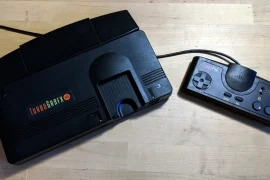
The TurboGrafx-16 Mini is one of those rare retro releases that caught me by surprise in all the right ways. For years, I had to rely on emulators or original hardware to enjoy NEC’s underdog console. But now, with the arrival of the Mini version, everything I loved about the system has been packed into a sleek, palm-sized unit that’s faithful to its legacy. In this TurboGrafx-16 Mini Console Review, I’m diving deep into its design, game lineup, performance, and overall value as a retro gaming gem.
I’ve spent many hours playing on the TurboGrafx-16 Mini, comparing it to the original hardware, and testing every corner of its interface and functionality. Whether you’re a longtime fan or a curious newcomer, this detailed look will help you decide if this micro-console is worth adding to your setup.
First Impressions and Design
Unboxing the TurboGrafx-16 Mini brought a rush of nostalgia. The console’s exterior is a nearly perfect replica of the original North American version, complete with the ridged top, cartridge slot (non-functional), and familiar branding. It’s roughly half the size of the original but maintains its retro charm in every curve and detail.
The build quality exceeded my expectations. It doesn’t feel like a cheap toy; it’s solid, with tight seams and quality plastic. The power button has a satisfying click, and while the controller ports are USB instead of the original design, they still preserve the retro look. One controller comes in the box, modeled closely after the original TurboPad. It feels great in hand, with responsive buttons and a crisp D-pad.
For those who care about display aesthetics as much as gameplay, the TurboGrafx-16 Mini fits right in with other mini consoles on a shelf. It’s lightweight but doesn’t slide around on a flat surface, and the HDMI and power ports are discreetly placed in the rear.
Menu Interface and Features
Booting up the system greets you with a stylish and functional user interface. The menu is responsive, colorful, and loaded with features. Each game is displayed with box art, and there’s an option to switch between the North American and Japanese interface styles, depending on which version of a game you’re about to play.
The TurboGrafx-16 Mini allows for save states with each game, making it easier to revisit tough sections or enjoy more casual play sessions. This modern touch doesn’t detract from the authenticity but enhances usability. There’s also a variety of display filters available, including pixel-perfect mode, CRT scanlines, and stretching options for widescreens.
For this TurboGrafx-16 Mini Console Review, I tested all three visual settings across several games. The scanline filter adds a dose of nostalgia without making the screen look blurry, and the pixel-perfect mode is a must if you’re playing on a modern flat panel and want crisp, accurate visuals.
Game Library and Hidden Surprises
One of the standout features of the TurboGrafx-16 Mini is its game library. It comes pre-loaded with 57 titles, 24 North American TurboGrafx-16 games and 33 Japanese PC Engine games. Some might wonder why Japanese titles are included, but most are playable without understanding Japanese, especially the action and shooter games.
Titles like Bonk’s Revenge, Ninja Spirit, R-Type, and Blazing Lazers show off the system’s capabilities and still play great today. Meanwhile, Japanese exclusives such as Castlevania: Rondo of Blood, Snatcher, and Star Parodier elevate the console beyond a simple nostalgia play. Many of these games were rare or expensive in physical form, so their inclusion adds immense value.
I spent hours exploring each game, from quirky titles like JJ & Jeff to intense shooters like Lords of Thunder. There are even a few hidden titles unlocked by holding certain buttons at the main menu, offering a fun bonus for curious players. In this TurboGrafx-16 Mini Console Review, I can confidently say that the game selection is one of the richest and most diverse of any mini console released so far.
Controller Performance and Expandability
The controller included with the console is faithful to the original TurboPad in almost every way. The buttons are slightly softer, but it feels natural and responsive. The turbo switches work as expected, making shooters much more manageable.
My only gripe is the inclusion of a single controller. Many of the games are multiplayer-compatible, so having just one pad feels limiting. Thankfully, you can purchase official or third-party USB-compatible controllers to expand your setup. There’s also a multitap available, allowing for up to five players in supported games like Bomberman ‘93.
During this TurboGrafx-16 Mini Console Review, I tested the multiplayer setup using an aftermarket multitap and extra USB controllers. It worked without a hitch, and the system instantly recognized the additional inputs. If you’re planning group play, it’s worth investing in a multitap right away.
Performance and Emulation Accuracy
Where the TurboGrafx-16 Mini truly shines is in its emulation quality. Developed in collaboration with M2, the emulation is top-tier. M2 is known for handling classic game ports with care, and they did an excellent job here. Frame rates are smooth, audio is accurate, and input lag is virtually non-existent.
Games like Dracula X: Rondo of Blood and Alien Crush perform flawlessly, even during intense action sequences. The Mini handles sprite-heavy scenes with no slowdowns or screen tearing. I even tested the emulation on a large 4K television, and while the games obviously weren’t built for that resolution, they still held up surprisingly well.
It’s worth noting that the TurboGrafx-16 Mini also does a solid job preserving aspect ratios. Unlike some older plug-and-play systems that stretch or distort games, this one offers a faithful visual experience, particularly when using the 4:3 mode with the scanline filter.
Missing Titles and Limitations
While I’m thoroughly impressed by the game library, there are a few notable absences. Games like Cadash, Legend of Hero Tonma, and Keith Courage in Alpha Zones didn’t make the cut. Licensing issues likely prevented some of these titles from being included, and while understandable, it’s a minor disappointment.
There’s also no SD card slot or way to add additional games officially, so what’s included is what you get. For most players, this won’t be a problem, given how generous the selection is. Still, modders have already found ways to expand the library unofficially, though that falls outside the scope of this TurboGrafx-16 Mini Console Review.
Audio Quality and Nostalgia Factor
The sound on the TurboGrafx-16 Mini is another strong point. It reproduces the chiptune and synthesized soundtracks of the original system with impressive fidelity. Games like Ys Book I & II and Lords of Thunder sound amazing on a modern audio setup.
One thing I noticed while playing through several sound-rich titles was how balanced the audio mix remained. There’s no tinny distortion or weird volume spikes that plague other mini consoles. Whether using TV speakers or headphones, the experience is clean and faithful to the original hardware.
This accuracy plays a huge role in maintaining the nostalgic vibe. The TurboGrafx-16 had a distinctive sound palette, and hearing those familiar tunes again adds emotional weight to the whole experience. For long-time fans, this detail will be deeply appreciated.
Price Point and Collector Appeal
At launch, the TurboGrafx-16 Mini retailed for around $100 USD, and while that’s not cheap, it delivers incredible value. The number of games, quality of emulation, and faithful design all justify the cost. Considering the price of original TurboGrafx-16 games on the secondary market, owning this mini console is actually a budget-friendly way to enjoy the platform’s best offerings.
Now that the console is a couple of years past release, prices can vary depending on the seller and region. It’s becoming harder to find brand-new units at retail price, so grabbing one while they’re still available is a good idea for collectors. I’ve seen boxed versions appreciating in value, especially for the Japanese PC Engine Mini and European CoreGrafx Mini variants.
In terms of collectibility, the TurboGrafx-16 Mini holds a special place. Unlike more mainstream consoles from Nintendo or Sega, this one caters to a more niche audience. That gives it a unique status in the retro gaming world. It’s not just another nostalgic cash grab, it’s a genuine tribute to a beloved but underappreciated system.
Final Verdict
In wrapping up this TurboGrafx-16 Mini Console Review, I have to say this little machine exceeds expectations in nearly every category. It’s not just a novelty item, it’s a fully functional, well-crafted homage to one of gaming’s most unique consoles. From the meticulous emulation to the thoughtful game selection and sharp user interface, it’s clear a lot of love went into this release.
Whether you’re revisiting childhood favorites or discovering the TurboGrafx-16 for the first time, this Mini makes it incredibly accessible and enjoyable. The inclusion of Japanese PC Engine games adds immense depth, and the attention to detail in both hardware and software makes this one of the best retro console releases to date.
For casual players, it’s a great plug-and-play experience with minimal setup. For collectors, it’s a beautiful tribute piece packed with value. And for retro gaming enthusiasts, it’s a deep dive into a fascinating era of gaming history that deserves more recognition.
If you’ve been on the fence about this one, I can say without hesitation that it deserves a place in your retro collection. The TurboGrafx-16 Mini Console Review wouldn’t be complete without a hearty recommendation, because this isn’t just a tiny console. It’s a tiny masterpiece.